


How to Challenge Eminent Domain Public Use for Private Development?
For over two decades in Constitutional Law, I've witnessed the profound distress and often bewildering confusion property owners face when confronted with eminent domain. It's a fundamental power of the government, enshrined in the Fifth Amendment, but its application, especially when it veers towards private development, is a complex and frequently contested arena. I've seen countless individuals and families feel powerless, believing their fight against a powerful government or well-funded developer is futile.
The problem is stark: your cherished property, a home, a business, or a piece of land, suddenly becomes a target for a project that promises 'public benefit' but appears to primarily serve private financial interests. The line between legitimate public use and private gain can become incredibly blurred, leaving property owners feeling unjustly targeted and their constitutional rights threatened. This isn't just a legal battle; it's often a deeply personal one, impacting livelihoods, legacies, and peace of mind.
In this definitive guide, I will share the strategies, legal frameworks, and expert insights I've gathered from years of practice. We'll delve into actionable steps, examine critical legal precedents, and explore how you, as a property owner, can mount a robust defense against eminent domain actions that masquerade as public use but are truly designed for private development. You'll learn not just what your rights are, but precisely how to exercise them effectively.
Understanding the "Public Use" Conundrum in Eminent Domain
At the heart of any eminent domain challenge lies the Fifth Amendment's "Takings Clause," which states, "nor shall private property be taken for public use, without just compensation." While the "just compensation" aspect is often debated, the "public use" requirement is where most challenges to private development takings originate. What exactly constitutes 'public use' has been a dynamic and often controversial legal interpretation.
The Fifth Amendment's "Takings Clause"
Historically, "public use" was interpreted quite literally: the property had to be physically used by the public, like for roads, schools, or post offices. Over time, however, courts expanded this definition to "public purpose" or "public benefit," allowing takings for projects that, while not directly accessible to the public, served a broader community interest, such as urban renewal or economic development. This shift opened the door for more expansive government action and, consequently, more potential for abuse.
The core principle, as I've always emphasized to my clients, is that the government must demonstrate a genuine public need or purpose for the taking. This isn't a mere formality; it's a constitutional safeguard. If the primary beneficiary is a private entity, and the public benefit is merely incidental or speculative, then the taking may be unconstitutional. Understanding this distinction is your first line of defense.
The Kelo v. City of New London Aftermath
No discussion of eminent domain for private development is complete without addressing the landmark 2005 Supreme Court case, Kelo v. City of New London. In Kelo, the city condemned private property to transfer it to a private developer for an economic revitalization project. The Supreme Court, in a controversial 5-4 decision, ruled that economic development qualified as "public use" under the Fifth Amendment, even if the property was then transferred to a private entity. This decision sent shockwaves through the property rights community.
"Kelo v. City of New London fundamentally altered the landscape of eminent domain, expanding the interpretation of 'public use' to include economic development. While intended to promote growth, it inadvertently empowered governments to take private property for the benefit of other private entities, sparking a nationwide outcry and legislative reforms." - An Industry Specialist's View
The Kelo decision essentially allowed governments to take private land from one owner and give it to another private owner if the second owner's project promised to generate more taxes or jobs. This wasn't about building a road; it was about perceived economic gain. The public reaction was swift and overwhelmingly negative, leading to significant legislative changes at the state level, which we will explore further.
Strategy 1: Scrutinizing the Public Use Justification
The first and most critical step in challenging eminent domain for private development is to meticulously scrutinize the stated "public use" justification. Often, these justifications are vague or thinly veiled attempts to benefit a private developer. Your goal is to expose the true nature of the project and demonstrate that the public benefit is either non-existent, negligible, or merely a pretext for private gain.
Defining "Public Use" vs. "Public Purpose"
While courts have broadened "public use" to "public purpose," there's still a critical distinction. A true public purpose serves the general welfare directly, like infrastructure or genuine blight remediation. A private purpose, even if it creates jobs or tax revenue, primarily benefits the developer. In many cases, the government will try to argue that any economic development inherently serves a public purpose. Your challenge is to show that the proposed development's public benefits are speculative, minimal, or could be achieved through less intrusive means.
I always advise my clients to ask: Who truly benefits the most from this project? If the answer is primarily a private corporation, then you have a strong argument that the public use requirement is not genuinely met. This requires a deep dive into the project's financials, development agreements, and any public statements made by the condemning authority or developer.
Identifying Pretextual Takings
A pretextual taking occurs when the government states a public purpose but the real reason for the taking is to facilitate a private project. This is a common tactic in eminent domain for private development. For instance, a city might declare an area "blighted" to justify taking properties, only to immediately transfer them to a private developer who has no intention of addressing blight, but rather building luxury condos or a shopping mall.
- Examine the Timeline: Was the "public use" declared only after a private developer expressed interest?
- Review Public Records: Request all documents related to the project, including feasibility studies, development agreements, and correspondence between the city and developers.
- Identify Developer Influence: Look for evidence of private developers lobbying for the condemnation or having significant input in the project's planning stages.
- Assess Project Viability: Is the stated public benefit (e.g., job creation, tax revenue) realistic, or is it an overinflated projection?
- Compare Alternatives: Were other, less invasive options considered to achieve the stated public purpose?
These investigative steps are crucial. They provide the factual basis for arguing that the government's stated public use is a mere pretext, designed to pave the way for private profit at your expense. Many successful challenges hinge on uncovering such discrepancies.
Strategy 2: Leveraging State-Specific Protections and Reforms
Following the public backlash against the Kelo decision, nearly every state enacted some form of eminent domain reform. These reforms vary widely, but many aim to restrict the use of eminent domain for private economic development. Understanding your state's specific laws is paramount.
Post-Kelo Legislative Responses
The Kelo decision ignited a powerful property rights movement, leading state legislatures to either amend their constitutions or pass new statutes to limit eminent domain power. Some states completely prohibited the taking of private property for transfer to another private entity, even for economic development. Others imposed stricter definitions of "blight" or required a heightened burden of proof for public use. Still others mandated longer notice periods or increased compensation for property owners.
I've seen firsthand how these state-level reforms can be game-changers. What might have been permissible under federal interpretation post-Kelo is often explicitly forbidden under state law. This creates a powerful avenue for challenging eminent domain actions that would otherwise be difficult to fight.
Understanding Your State's Anti-Kelo Laws
It's imperative to research and understand the specific eminent domain laws in your state. This often requires delving into state statutes and possibly even your state's constitution. An experienced eminent domain attorney in your jurisdiction will be invaluable here, as they can navigate the nuances of local legislation and judicial interpretations.
For example, some states require a "supermajority" vote by a legislative body to approve a taking for economic development, while others might mandate that the property remain in public ownership for a certain period. Knowing these specific provisions allows you to pinpoint potential violations by the condemning authority. The Institute for Justice offers a comprehensive overview of state-by-state reforms, which is an excellent starting point for your research.
| Reform Type | Description | Example States |
|---|---|---|
| Complete Ban on Private-to-Private Transfer | Prohibits eminent domain for economic development even if public benefits are cited. | AR, FL, MT, SC |
| Stricter 'Blight' Definitions | Narrows the criteria for declaring an area blighted, making it harder to justify takings. | GA, IL, MI, NV |
| Heightened Evidentiary Standards | Requires governments to prove public use by 'clear and convincing' evidence, not just 'preponderance'. | AL, CO, KS |
| Increased Compensation Requirements | Mandates compensation beyond fair market value, often 125-150% of market value. | LA, ND, SD, TX |
This table illustrates the diversity of post-Kelo reforms. Your attorney will help you identify which of these, or other specific protections, apply to your situation and how to best utilize them in your defense.
Strategy 3: Challenging "Blight" Designations and Necessity
One of the most common justifications for eminent domain, particularly for urban redevelopment and private development, is the declaration of an area as "blighted." This designation is often subjective and can be manipulated to serve development interests. Challenging a blight designation, or the necessity of the taking, can be a powerful strategy.
The Subjectivity of Blight
"Blight" is a legal term that typically refers to areas suffering from deterioration, neglect, or economic stagnation. However, the criteria for what constitutes blight can be incredibly broad and open to interpretation. I've observed cities declare areas blighted based on factors as minor as cracked sidewalks or a few vacant storefronts, even when the properties targeted for taking are well-maintained and thriving. This subjectivity is where your challenge can gain traction.
Your goal is to demonstrate that the area, or your specific property, does not meet the legal definition of blight under state or local law. This requires gathering evidence such as property maintenance records, photographs, inspection reports, and expert testimony from urban planners or real estate appraisers who can counter the condemning authority's claims. Don't let them define your property out of existence without a fight.
Proving Lack of Necessity or Alternative Sites
Even if a public use or blight designation is upheld, the government must also demonstrate that the taking of your specific property is "necessary" for the project. This means arguing that there are no reasonable alternatives to achieve the stated public purpose that would be less disruptive to private property rights. This is a high bar for the government to meet, and often they fail to adequately explore other options.
Case Study: How the "Main Street Coalition" Saved Downtown
In a mid-sized city, the local Redevelopment Authority declared a vibrant, historic downtown block "blighted" to make way for a new mixed-use development proposed by a major national developer. The Authority cited minor structural issues in a few buildings and a perceived lack of "modern amenities." Property owners, forming the "Main Street Coalition," engaged an eminent domain attorney. Their strategy focused on two key areas:
- Challenging Blight: They commissioned an independent urban planning firm, which presented a detailed report demonstrating that the area, while historic, was economically vibrant, had high occupancy rates, and contributed significantly to the city's tax base. They provided photos of well-maintained facades and thriving businesses, directly contradicting the Authority's vague blight claims.
- Proving Lack of Necessity: The Coalition's attorney highlighted that the proposed development could easily be built on several nearby vacant parcels or underutilized industrial sites, which the city had not adequately considered. They also showed that the existing businesses were willing to invest in upgrades, given proper incentives, negating the need for demolition.
The court, swayed by the robust evidence and the community's organized opposition, ruled in favor of the property owners, finding that the blight designation was arbitrary and that the city had failed to demonstrate genuine necessity for taking these specific properties. This resulted in the developer pursuing an alternative site and the downtown businesses continuing to thrive, a testament to the power of a well-executed challenge.
Strategy 4: Demanding True "Just Compensation"
Even if a taking is deemed constitutional, you still have the right to "just compensation." This isn't just the fair market value of your property; it encompasses a broader range of damages and losses. Many property owners, in their haste or distress, accept initial offers that are far below what they are legally entitled to. In my experience, the initial offer is almost never the final offer.
Beyond Fair Market Value: Consequential Damages
"Just compensation" is intended to make the property owner whole, putting them in the same financial position they would have been in had the taking not occurred. This often includes more than just the market value of the land and improvements. It can also include:
- Relocation Costs: Expenses for moving a home or business.
- Business Losses: Loss of profits, goodwill, and business interruption during relocation.
- Fixture and Equipment Losses: Costs associated with disconnecting, moving, and reconnecting machinery and equipment.
- Diminution in Value of Remaining Property: If only a portion of your property is taken, the remaining parcel might decrease in value due to severance damages.
- Loss of Access or Visibility: If the taking impacts customer access or visibility for a business.
These consequential damages are often overlooked by condemning authorities in their initial offers, but they can significantly increase the total compensation you receive. An expert appraiser and an experienced attorney are crucial for identifying and quantifying these often-complex losses.
Negotiating for Relocation Assistance and Business Losses
Don't assume the condemning authority will proactively offer all available assistance. It's your responsibility, with legal guidance, to demand it. The Uniform Relocation Assistance and Real Property Acquisition Policies Act (URA) provides federal guidelines for relocation benefits for those displaced by federally funded projects, and many states have similar laws. These benefits can cover not only moving expenses but also reestablishment costs, re-housing payments, and even business re-start assistance.
- Document Everything: Keep meticulous records of all expenses related to potential relocation, business interruption, and property improvements.
- Engage Independent Appraisers: Do not rely solely on the government's appraisal. Hire your own expert to get an independent valuation, including consequential damages.
- Calculate Business Goodwill: If you operate a business, work with forensic accountants to determine losses in business goodwill and future profits.
- Consider Leasehold Interests: If you are a tenant, you may also be entitled to compensation for your leasehold interest and business losses.

These steps are foundational to ensuring you receive truly "just compensation." It's not about getting rich; it's about being made whole.
Strategy 5: Building a Strong Legal and Community Coalition
Fighting eminent domain, especially when it involves private development, is rarely a solitary endeavor. The government and developers often have vast resources. Your most potent counter-force will be a combination of expert legal counsel and a united community front.
The Power of Legal Counsel Specializing in Eminent Domain
I cannot stress this enough: do not attempt to navigate eminent domain alone. This is an incredibly specialized area of law. An attorney who focuses on eminent domain will understand the nuances of constitutional law, state statutes, local ordinances, and valuation methodologies. They can:
- Evaluate the legality of the taking.
- Challenge the public use or necessity.
- Negotiate for maximum compensation.
- Represent you in court if litigation becomes necessary.
- Connect you with expert appraisers, urban planners, and other professionals.
Hiring an attorney early in the process is critical. They can advise you even before formal condemnation proceedings begin, often preventing costly mistakes and positioning you for a stronger outcome. Many eminent domain attorneys work on a contingency basis, meaning they only get paid if you win, making their services accessible.
Community Organizing and Public Relations
Governments are sensitive to public opinion. When a community unites against a perceived eminent domain abuse, it can create significant political pressure. Organizing your neighbors, sharing information, and presenting a united front can sway public officials and even developers.
- Form a Neighborhood Association: Create a formal or informal group to share information and coordinate efforts.
- Engage Local Media: Share your story with local newspapers, TV stations, and online news outlets. Public awareness can generate support and put pressure on officials.
- Attend Public Meetings: Speak at city council meetings, planning commission hearings, and other public forums to voice your concerns.
- Lobby Local Officials: Directly contact your elected representatives to explain how the proposed taking impacts you and the community.
"In the face of formidable governmental power, the collective voice of a united community, armed with legal strategy and public awareness, often proves to be the most formidable weapon against eminent domain abuse." - A Veteran Constitutional Lawyer
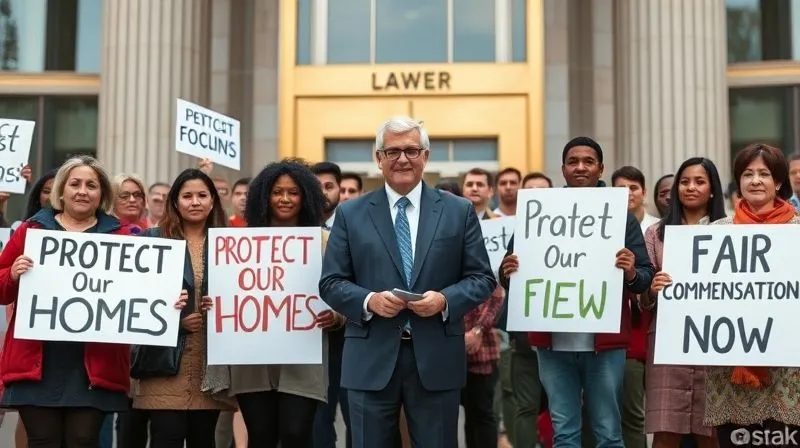
A well-coordinated public relations campaign, working in tandem with your legal strategy, can significantly increase your chances of success. It transforms a private dispute into a public issue, making it harder for the condemning authority to proceed unchallenged.
Navigating the Litigation Process: What to Expect
While negotiation is always the preferred first step, be prepared for the possibility of litigation. Understanding the eminent domain litigation process can help alleviate anxiety and empower you to make informed decisions.
Pre-Condemnation Negotiations
Before filing a lawsuit, the condemning authority is usually required to engage in good-faith negotiations to purchase your property. This is your first opportunity to challenge their offer and present your own valuation. Your attorney will play a crucial role here, preparing counter-offers, presenting evidence of higher value, and arguing against the public use or necessity of the taking. Many cases are resolved during this phase without ever going to court.
Filing an Inverse Condemnation Claim
In some situations, the government might not formally condemn your property but takes actions that severely diminish its value or usability, effectively taking it without compensation. In such cases, your attorney might file an "inverse condemnation" claim, seeking compensation for the de facto taking. This is a complex area, but it's an important tool for property owners whose rights have been infringed upon without a formal eminent domain proceeding.
Trial and Appeals
If negotiations fail, the case will proceed to court. This involves discovery, where both sides exchange information, followed by a trial. During the trial, your attorney will present evidence, call expert witnesses (appraisers, urban planners), and cross-examine the condemning authority's witnesses. The goal is to convince the court that either the taking is unconstitutional (e.g., no legitimate public use) or that the offered compensation is insufficient. If either party is dissatisfied with the trial's outcome, there is typically a right to appeal to a higher court.
| Phase | Description | Action for Owner |
|---|---|---|
| Initial Offer & Appraisal | Government provides an initial offer based on their appraisal, often low. | Do NOT accept immediately; seek independent appraisal and legal counsel. |
| Good-Faith Negotiations | Parties attempt to reach a settlement outside of court. | Present counter-offers with expert valuations, challenge public use claims. |
| Filing of Condemnation Lawsuit | If negotiations fail, government files suit to legally take property. | Your attorney files an answer, raising defenses like lack of public use or necessity. |
| Discovery & Pre-Trial Motions | Both sides exchange evidence, depose witnesses, and file motions. | Cooperate with your attorney, provide all requested documents and information. |
| Trial | Case heard by judge or jury, evidence presented, witnesses testify. | Be prepared to testify, support your attorney's strategy. |
| Appeal | If dissatisfied with trial outcome, either party can appeal to a higher court. | Consult with attorney on grounds for appeal and potential outcomes. |

This process can be lengthy and emotionally taxing, but with the right legal team, you can effectively assert your rights and fight for a just outcome. Remember, the system is designed to allow for these challenges, and many property owners have successfully defended their land or secured significantly higher compensation.
Frequently Asked Questions (FAQ)
Question? Can private property *ever* be taken for private development constitutionally?
Answer: While the Kelo decision broadened the interpretation of "public use" to include economic development, allowing private-to-private transfers, most states have since enacted reforms limiting this power. Generally, such takings are only constitutional if there's a clear, overwhelming public benefit (often defined by state law) that cannot be achieved by other means, and the primary purpose isn't simply to enrich a private developer. It's a highly scrutinized area, and proving a genuine public benefit is a high bar. Some states have outright banned it.
Question? What's the very first step I should take if a government entity contacts me about eminent domain for a private development project?
Answer: The absolute first step is to consult with an experienced eminent domain attorney. Do NOT sign any documents, grant access for appraisals or surveys without legal advice, or make any commitments. An attorney can explain your rights, evaluate the legality of the proposed taking, and guide you through every subsequent step, ensuring you don't inadvertently waive any rights or accept an inadequate offer.
Question? How much does it typically cost to fight eminent domain?
Answer: The cost varies significantly depending on the complexity of the case, the value of the property, and whether it settles or goes to trial. Many eminent domain attorneys work on a contingency fee basis for the "just compensation" aspect, meaning they receive a percentage of the amount recovered above the government's initial offer. For challenging the "public use" or "necessity" of the taking, legal fees might be hourly. Some states also have provisions allowing property owners to recover legal fees if they successfully challenge the taking or secure substantially higher compensation. Discuss fee structures thoroughly with your attorney.
Question? What if my property isn't "blighted" but the government declares it is to facilitate a private development?
Answer: This is a common tactic and a strong basis for challenging the eminent domain action. You have the right to dispute the blight designation. Your attorney can help you gather evidence such as independent appraisals, property inspection reports, photographs, and expert testimony from urban planners to demonstrate that your property, or the area, does not meet the legal definition of blight. Many state reforms have also tightened blight definitions, making it harder for governments to use this pretextually.
Question? Can I get more than just the "fair market value" for my property in an eminent domain case?
Answer: Absolutely. "Just compensation" under the Fifth Amendment is often interpreted to mean more than just fair market value. It typically includes the fair market value of your property, but can also encompass consequential damages such as relocation expenses, business losses (loss of profits, goodwill), loss of access, and severance damages if only a portion of your property is taken. An experienced eminent domain attorney, working with qualified appraisers, will help identify and quantify all potential damages to ensure you are made whole.
Key Takeaways and Final Thoughts
- Scrutinize Public Use: Always challenge the stated public use, especially when private development is involved. Look for pretextual takings and primary private benefit.
- Leverage State Laws: Understand and utilize your state's post-Kelo eminent domain reforms, which often provide stronger protections than federal law.
- Challenge Blight & Necessity: Actively dispute subjective blight designations and demand proof that taking your specific property is truly necessary for the project.
- Demand True Just Compensation: Do not settle for the initial offer. Seek independent appraisals and claim all consequential damages, including relocation and business losses.
- Build a Coalition: Engage specialized legal counsel early and consider forming a community coalition to amplify your voice and exert public pressure.
The fight against eminent domain for private development is undoubtedly challenging, but it is far from hopeless. As an experienced industry specialist, I've seen countless property owners successfully defend their rights, either by stopping the taking altogether or by securing significantly higher compensation. Your property rights are fundamental, and with the right knowledge, legal strategy, and a determined spirit, you can stand firm against unjust condemnation. Remember, you have a voice, and you have rights – use them. Seek expert guidance, stay informed, and never underestimate the power of a well-prepared and unified defense.
Recommended Reading
- Adoption Disrupted? What Happens Legally If An Adoption Fails
- 5 Critical Strategies: Resolve Commercial Property Title Defects Fast
- NFT IP Theft: 7 Legal Steps to Reclaim Your Digital Art Rights
- 7 Layers of Defense: Preventing Unauthorized Algorithm Use Online
- 7 Essential Strategies: Protecting Secured Creditor Rights in Chapter 11





Comments
Leave a comment below. Your email will not be published. Required fields marked with *