


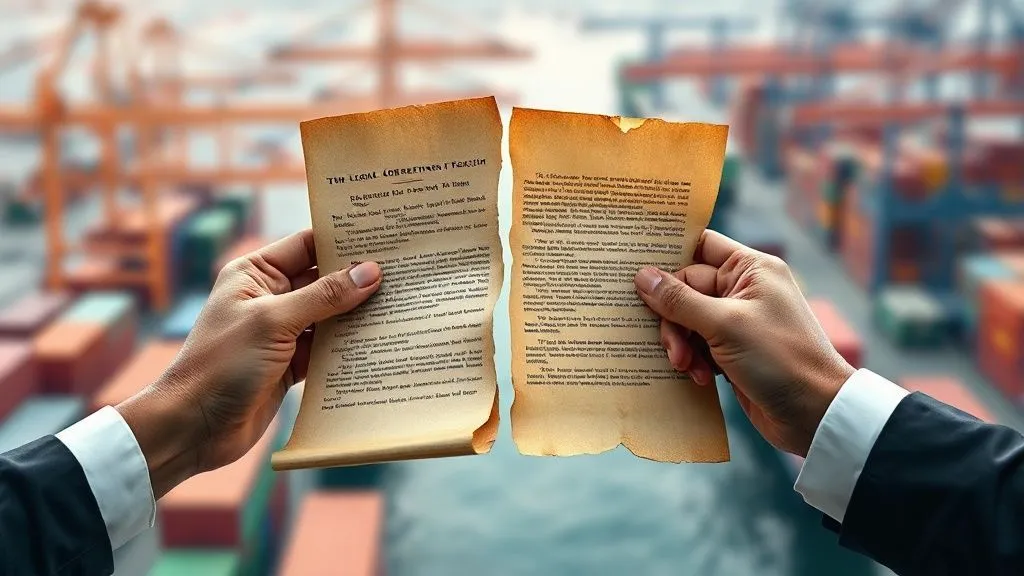
How to Reconcile Conflicting International Trade Legal Frameworks?
For over two decades navigating the intricate currents of international law, I've witnessed firsthand the paralyzing effect of conflicting legal frameworks on global trade operations. It’s a challenge that can stall multi-million dollar deals, lead to costly litigation, and erode trust between nations and corporations. I recall a particular instance where a seemingly straightforward cross-border merger nearly collapsed due to an unforeseen clash between regional trade agreements and a specific WTO ruling. The complexity isn't just theoretical; it's a very real, tangible barrier that demands expert navigation.
The global marketplace, while offering unprecedented opportunities, is also a dense tapestry of regulations, treaties, and domestic laws. When these frameworks, designed to foster trade, instead diverge or outright contradict each other, businesses find themselves in an untenable position. This isn't just about compliance; it's about operational continuity, market access, and ultimately, profitability. The question isn't if you'll encounter such conflicts, but how prepared you are to address them decisively and strategically.
In this definitive guide, I will draw upon my extensive experience to demystify the complexities surrounding conflicting international trade legal frameworks. We’ll explore the underlying causes of these clashes and, more importantly, equip you with five robust, actionable strategies to reconcile them effectively. From understanding treaty hierarchies to leveraging advanced interpretive tools and proactive risk management, you’ll gain the expert insights needed to navigate these legal labyrinths, ensuring your international ventures remain compliant, profitable, and strategically sound.
Understanding the Labyrinth of International Trade Law
Before we delve into reconciliation, it's crucial to grasp the multifaceted nature of international trade law itself. It's not a single, monolithic code but a dynamic interplay of various sources. I’ve often observed that many legal professionals, while adept in domestic law, underestimate the unique challenges posed by this global mosaic. The primary sources include multilateral treaties like those under the World Trade Organization (WTO), regional trade agreements (RTAs) such as NAFTA (now USMCA) or the EU's common market, and bilateral investment treaties (BITs). Beyond these, customary international law, general principles of law, and even scholarly writings and judicial decisions play a significant role in shaping its contours.
The sheer volume and diversity of these instruments mean that overlaps and conflicts are not just possibilities, but inevitabilities. Each agreement is negotiated by sovereign states with their own national interests, legal traditions, and political agendas. This inherent divergence sets the stage for potential clashes, creating a complex legal environment where clarity is often elusive. Understanding this foundational complexity is the first step in developing effective strategies to reconcile conflicting international trade legal frameworks.
The Core Causes of Legal Framework Conflict in Global Trade
Why do these conflicts arise? In my experience, the causes are deeply rooted in the very structure of international relations and legal development. Firstly, sovereignty remains a cornerstone; states retain the right to legislate within their borders, often leading to domestic laws that may contradict or impose higher standards than international obligations. Secondly, the fragmentation of international law itself contributes significantly. New treaties are constantly being negotiated without always explicitly addressing their relationship with existing ones, leading to an intricate web of overlapping commitments.
Thirdly, different legal traditions and philosophies (e.g., common law vs. civil law systems) can lead to varied interpretations of similar provisions. For instance, the concept of 'force majeure' might be applied differently across jurisdictions. Fourthly, the rise of sector-specific regulations – encompassing areas like environmental protection, labor standards, or digital trade – adds another layer of complexity. These specialized regimes, while vital, can sometimes conflict with broader trade liberalization objectives. Finally, the absence of a truly universal legislative body means there's no single authority to proactively harmonize or resolve these discrepancies, leaving it to states, tribunals, and practitioners to navigate these treacherous waters.
Strategy 1: Prioritizing Treaty Obligations and Hierarchy
One of the most fundamental strategies I advocate for when confronting conflicting international trade legal frameworks is to establish a clear hierarchy of obligations. This isn't always straightforward, but international law provides established principles. The Vienna Convention on the Law of Treaties (VCLT), often considered the 'treaty on treaties,' offers crucial guidance. Article 30 of the VCLT, for instance, addresses the application of successive treaties relating to the same subject matter. It essentially states that if a later treaty is silent on its relationship with an earlier one, and all parties are the same, the earlier treaty applies only to the extent that its provisions are compatible with the later one.
Furthermore, two key Latin maxims are indispensable: lex specialis derogat legi generali (special law overrides general law) and lex posterior derogat legi priori (later law overrides earlier law). When faced with a conflict, determining which legal instrument is more specific to the particular issue at hand, or which was adopted more recently, can provide a robust basis for prioritizing. For example, a specific bilateral trade agreement on agricultural subsidies might take precedence over a more general WTO agreement on subsidies, given its specialized nature. Understanding and applying these principles correctly is paramount for legal clarity. For detailed insights into treaty interpretation, consult the Vienna Convention on the Law of Treaties.
Strategy 2: Leveraging Interpretive Tools and Principles
Beyond hierarchy, the art of interpretation is a powerful tool in resolving ambiguities and perceived conflicts. International law, like any legal system, relies heavily on how its provisions are understood and applied. Article 31 of the VCLT provides a gold standard for treaty interpretation, emphasizing a 'good faith' approach. This means interpreting a treaty in accordance with the ordinary meaning to be given to the terms in their context and in light of its object and purpose. I frequently guide clients through this process, urging them to look beyond the literal text to understand the underlying intentions of the contracting parties.
The 'context' includes not only the text itself but also any agreement relating to the treaty made between all the parties in connection with its conclusion, and any instrument made by one or more parties in connection with the conclusion of the treaty and accepted by the other parties as an instrument related to the treaty. Furthermore, 'object and purpose' refers to the treaty's overall goals and aims, which can shed light on ambiguous provisions. Supplementary means of interpretation, such as the travaux préparatoires (preparatory work of the treaty) and the circumstances of its conclusion, can also be used to confirm meaning or to determine meaning when the primary methods leave it ambiguous or lead to an absurd result. Mastering these interpretive techniques allows legal teams to creatively and logically reconcile conflicting international trade legal frameworks.
Expert Insight: "Interpretation is not about finding new meaning, but about uncovering the original intent of the parties within the framework of evolving global realities. A robust interpretive strategy can turn a perceived conflict into a coherent legal pathway."
Strategy 3: The Role of Dispute Settlement Mechanisms
When preventive measures and interpretive efforts fail to reconcile conflicting international trade legal frameworks, formal dispute settlement mechanisms become indispensable. These mechanisms provide a structured process for resolving disagreements and enforcing compliance. The most prominent example is the World Trade Organization's Dispute Settlement Body (DSB). The WTO system is unique in its quasi-judicial nature, offering a forum for members to challenge trade measures inconsistent with WTO agreements. Its rulings are binding and have significantly shaped international trade law jurisprudence. I've personally advised on cases where a clear understanding of WTO rulings provided the necessary leverage to resolve complex trade barriers.
Beyond the WTO, other avenues include the International Court of Justice (ICJ) for state-to-state disputes, and various forms of international arbitration (e.g., under the International Chamber of Commerce (ICC) or the International Centre for Settlement of Investment Disputes (ICSID)) for investor-state or commercial disputes. These arbitral bodies offer flexibility and often specialized expertise. Understanding the jurisdiction, procedural rules, and enforcement mechanisms of each is critical for choosing the most effective forum. Engaging these bodies requires meticulous preparation and a deep understanding of both procedural and substantive international law.
Case Study: Resolving a Dual Taxation Dispute
GlobalConnect Inc., a multinational tech firm, faced a significant challenge when its operations in Country A were subject to a new digital services tax, conflicting with a pre-existing Bilateral Investment Treaty (BIT) between Country A and Country B (GlobalConnect's home country), which protected against discriminatory taxation. Country A argued its new tax was a general revenue measure, while GlobalConnect contended it specifically targeted foreign digital companies, violating the BIT's fair and equitable treatment clause and a non-discrimination provision. After initial diplomatic discussions failed, GlobalConnect, acting on expert legal advice, initiated an arbitration claim under the BIT's provisions, leveraging the ICSID framework. The arbitration panel, applying principles of lex specialis (the BIT being more specific than Country A's general tax law in this context) and interpreting the BIT's non-discrimination clause in light of its object and purpose, ruled in favor of GlobalConnect. This not only prevented a multi-million dollar tax burden but also set a precedent for future digital trade taxation in the region. This case exemplifies how a well-chosen dispute settlement mechanism can effectively reconcile conflicting legal obligations and protect investor interests.

Strategy 4: Bilateral and Multilateral Harmonization Efforts
Proactive harmonization efforts, whether bilateral or multilateral, represent a crucial long-term strategy to reduce and reconcile conflicting international trade legal frameworks. These efforts aim to align laws and regulations across jurisdictions, thereby minimizing the potential for future clashes. Regional Trade Agreements (RTAs), Free Trade Agreements (FTAs), and Customs Unions are prime examples. The European Union, with its extensive body of harmonized law (the Acquis Communautaire), stands as a powerful testament to what comprehensive harmonization can achieve, even if its complexity can also generate new challenges.
Beyond regional blocs, international organizations like the United Nations Commission on International Trade Law (UNCITRAL) and the International Institute for the Unification of Private Law (UNIDROIT) play vital roles. They develop model laws, conventions, and legal guides that, while not always directly binding, serve as influential templates for national legislatures. For instance, UNCITRAL's Model Law on International Commercial Arbitration has been adopted by numerous countries, fostering greater uniformity in arbitration practices worldwide. Engaging with these harmonization efforts, either directly through government channels or indirectly through industry advocacy, can significantly mitigate future legal risks.
| Harmonization Approach | Key Benefit | Example |
|---|---|---|
| Regional Trade Agreements (RTAs) | Deep integration, comprehensive scope | European Union, USMCA |
| Model Laws/Conventions | Flexibility for national adoption, specific focus | UNCITRAL Model Law on Arbitration |
| Bilateral Investment Treaties (BITs) | Investor protection, specific dispute resolution | Thousands of bilateral treaties |
| Technical Standards Harmonization | Reduces non-tariff barriers, facilitates market access | ISO Standards, Codex Alimentarius |
Strategy 5: Proactive Risk Management and Legal Due Diligence
In my extensive career, I've seen that the most effective way to reconcile conflicting international trade legal frameworks often lies in prevention. This means embedding proactive risk management and rigorous legal due diligence into every aspect of international business operations. Before entering new markets, launching new products, or engaging in cross-border transactions, a thorough legal audit is non-negotiable. This audit should identify potential legal overlaps, inconsistencies, and compliance gaps between relevant international treaties, domestic laws, and industry-specific regulations.
Key steps include: (1) Mapping the Legal Landscape: Systematically identify all applicable international agreements and domestic laws. (2) Conflict Analysis: Specifically look for provisions that could clash, impose different standards, or create jurisdictional ambiguities. (3) Scenario Planning: Develop strategies for how to proceed if a conflict arises, including potential legal arguments or operational adjustments. (4) Contractual Safeguards: Incorporate robust choice of law, forum selection, and dispute resolution clauses into all international contracts. These clauses, when carefully drafted, can pre-emptively resolve many potential conflicts by establishing clear rules for engagement. According to a recent survey by the International Bar Association, companies that invest heavily in pre-emptive legal analysis report a 30% reduction in international legal disputes. For further reading on best practices in managing international legal risks, the International Bar Association's resources on International Commerce and Trade offer valuable insights.
Navigating Specific Sectoral Conflicts: A Practical Approach
While the general strategies discussed are broadly applicable, I find it crucial to highlight that specific sectors often present unique challenges when seeking to reconcile conflicting international trade legal frameworks. For instance, in the realm of environmental trade measures, conflicts frequently arise between WTO rules promoting free trade and national or regional environmental regulations designed to protect ecosystems or combat climate change. The EU's Carbon Border Adjustment Mechanism (CBAM), for example, has sparked debates about its compatibility with WTO principles.
Similarly, digital trade and data governance is a rapidly evolving area ripe with conflicts. Different national approaches to data localization, privacy (e.g., GDPR vs. CCPA), and cross-border data flows can create significant barriers for global tech companies. Another critical area is labor standards and human rights, where national laws or multilateral conventions (like those of the ILO) may impose obligations that conflict with trade liberalization objectives or supply chain realities. For each sector, the key is to understand the specific international conventions, customary practices, and domestic laws that apply, and then apply the interpretive and hierarchical tools with a nuanced understanding of the sector's unique policy objectives and sensitivities. This often requires engaging with specialized legal counsel and industry-specific advocacy groups.
Building an Internal Framework for Conflict Resolution
Beyond external strategies, I consistently advise organizations to build a robust internal framework for identifying, assessing, and resolving potential conflicts between international trade legal frameworks. This is not merely a legal department's responsibility; it requires cross-functional collaboration and a culture of proactive compliance. Your internal framework should begin with establishing clear lines of communication between legal, compliance, operations, and business development teams. Regular training sessions are essential to ensure that all relevant personnel understand the basics of international trade law and the potential for conflicts.
Developing an internal 'conflict matrix' or a 'compliance dashboard' can be incredibly effective. This tool would systematically track all relevant international agreements and domestic laws pertinent to your operations, highlight areas of potential overlap or conflict, and assign responsibility for monitoring and resolution. Furthermore, integrating legal review early in the strategic planning process – long before a deal is finalized or a product launched – can prevent costly issues down the line. This proactive, integrated approach ensures that the organization isn't just reacting to conflicts but is equipped to manage and reconcile them systematically, minimizing disruption and maximizing legal certainty. This is how you empower your team to effectively reconcile conflicting international trade legal frameworks on an ongoing basis.

| Step | Action | Responsible Dept. |
|---|---|---|
| 1. Legal Landscape Mapping | Identify all applicable international treaties, regional agreements, and relevant domestic laws. | Legal, Compliance |
| 2. Conflict Identification | Analyze provisions for overlaps, inconsistencies, or differing standards. | Legal, Business Development |
| 3. Risk Assessment & Prioritization | Evaluate the likelihood and impact of identified conflicts; prioritize based on severity. | Legal, Risk Management |
| 4. Strategy Formulation | Develop specific reconciliation strategies (e.g., interpretive arguments, contractual clauses, dispute resolution plans). | Legal, Operations |
| 5. Implementation & Monitoring | Execute strategies and continuously monitor legal developments and compliance. | Compliance, Legal, Operations |
Frequently Asked Questions (FAQ)
Q: What if conflicting international trade legal frameworks appear equally authoritative or specific? In such nuanced situations, applying the Vienna Convention on the Law of Treaties (VCLT) principles becomes even more critical. You'd primarily look to the 'object and purpose' of each treaty to discern which best addresses the specific issue at hand. Additionally, considering the 'subsequent practice' of the parties – how they have interpreted and applied the treaties over time – can provide strong guidance. If all else fails, resorting to dispute settlement bodies with a well-crafted argument based on general principles of international law, such as equity, might be necessary.
Q: How do domestic laws interact with international treaties when conflicts arise? This depends heavily on a state's constitutional framework, specifically whether it adheres to a monist or dualist approach. In monist states, international treaties automatically become part of domestic law upon ratification, and often take precedence. In dualist states, international treaties must be transformed into domestic law through legislative action to be enforceable domestically. If a conflict persists, the international obligation still stands, potentially leading to international state responsibility, even if domestic courts are bound by national law. Businesses must understand this interplay to assess their legal exposure.
Q: Can non-state actors, like NGOs or industry associations, influence the reconciliation of trade law conflicts? Absolutely. While formal reconciliation primarily rests with states, non-state actors play a crucial informal role. NGOs often advocate for specific interpretations or push for new treaties that address gaps or conflicts, particularly in areas like environmental protection or human rights. Industry associations provide valuable technical expertise and lobby governments to adopt harmonized standards or resolve specific trade barriers that impact their members. Their influence, though indirect, can significantly shape the political will and technical solutions required for reconciliation.
Q: What are the primary risks or costs of failing to reconcile conflicting international trade legal frameworks? The costs can be substantial and multifaceted. They include direct financial penalties such as fines, tariffs, and increased operational costs due to non-compliance. Furthermore, businesses face significant legal risks, including costly and protracted litigation or arbitration, potential loss of market access, and seizure of goods. Beyond the immediate financial impact, there's severe reputational damage, erosion of trust with trading partners, and the potential for diplomatic disputes between states. Ultimately, unresolved conflicts can hinder global economic growth and stability.
Q: What are some emerging trends that could exacerbate or alleviate future conflicts in international trade law? Emerging trends like the rapid growth of digital trade, the increasing focus on climate change and sustainability, and the rise of protectionist sentiments are certainly creating new areas of potential conflict. Digital services taxes, carbon border adjustments, and supply chain due diligence laws are all examples of new regulations that can clash with existing trade frameworks. However, there's also a growing recognition of the need for greater regulatory coherence and international cooperation, which could lead to more innovative and effective harmonization efforts, potentially alleviating some future conflicts through new multilateral agreements or revised dispute settlement mechanisms.
Key Takeaways and Final Thoughts
- Master Treaty Hierarchy: Always begin by assessing the hierarchy of applicable international agreements and domestic laws, leveraging principles like lex specialis and lex posterior.
- Employ Interpretive Tools: Utilize the Vienna Convention on the Law of Treaties' guidelines for interpreting provisions in good faith, considering context, object, and purpose.
- Strategic Dispute Resolution: Understand and strategically select the most appropriate dispute settlement mechanism, whether it's the WTO DSB, international arbitration, or other forums.
- Embrace Harmonization: Actively engage with or advocate for bilateral and multilateral harmonization efforts to prevent future conflicts and foster legal certainty.
- Proactive Due Diligence: Implement robust internal risk management and legal due diligence processes to identify and address potential conflicts before they escalate.
- Foster Cross-Functional Collaboration: Ensure your legal, compliance, and business teams work together to create an integrated framework for managing trade law complexities.
Navigating the complex landscape of international trade law is undoubtedly challenging, but it is far from insurmountable. By systematically applying these expert strategies, you can transform potential legal conflicts into manageable challenges, ensuring your global operations remain compliant, efficient, and strategically advantageous. Remember, in the world of international trade, foresight and meticulous preparation are your most powerful allies in achieving legal coherence and sustained success. I encourage you to integrate these principles into your daily practice, building resilience and certainty in your international ventures.
Recommended Reading
- Foreign Crew Injury: Navigating Legal Defense on International Waters
- Online Speech & True Threats: The 2 Key Tests You Need to Know
- Union Negotiations: 5 Proactive Ways to Prevent Unfair Labor Practices
- Stopping Unconstitutional Bills: 7 Pre-Vote Strategies for Citizens
- Enforce Non-Compete: 7 Steps to Protect Your Business & IP




Comments
Leave a comment below. Your email will not be published. Required fields marked with *