



Solving DACA Adjustment of Status Issues for Clients with Prior Entries?
For over two decades in immigration law, I've witnessed firsthand the profound impact of DACA on hundreds of thousands of lives. It's a program that offers crucial protection, but also one that often presents a labyrinth of complexities when DACA recipients seek to adjust their status to permanent residency. The question of prior entries, particularly undocumented ones, is arguably the most significant hurdle.
Many DACA recipients arrived in the U.S. as children without inspection, creating a fundamental challenge for the adjustment of status process. This prior unlawful entry can trigger bars to admissibility that seem insurmountable, leaving individuals and their families in a perpetual state of uncertainty. The dream of a green card, despite DACA protection, often feels just out of reach.
This article isn't just a breakdown of the rules; it's a strategic guide born from years of navigating these intricate waters. I'll walk you through the critical legal nuances, illuminate the pathways that genuinely exist, and equip you with the actionable frameworks and expert insights necessary to tackle DACA adjustment of status issues for clients with prior entries head-on, aiming for a successful outcome.
Understanding the Bedrock: Adjustment of Status Eligibility
To truly grasp the challenges, we must first understand the foundational requirements for adjustment of status. At its core, adjustment of status (Form I-485) allows an eligible individual to obtain lawful permanent resident status without having to leave the United States. This is often the most desirable path for DACA recipients, avoiding the risks associated with consular processing abroad.
However, the eligibility criteria are stringent. One of the most critical requirements, often overlooked or misunderstood, is the need for a "lawful admission" or "parole." This is where prior entries become a significant issue. Someone who entered the U.S. without inspection (EWI) generally does not meet this requirement, making them prima facie ineligible for adjustment under INA §245(a).
The "Entered Without Inspection" (EWI) Dilemma
For many DACA recipients, their initial entry into the U.S. was EWI. This means they did not present themselves to an immigration officer at a port of entry and were not formally admitted or paroled. Without a lawful admission, the path to adjustment of status under §245(a) is typically closed, regardless of a qualifying family or employment-based petition. This is the central problem we are trying to solve.
Expert Insight: The term "lawful admission" is not synonymous with "lawful presence." DACA grants lawful presence, but it does not retroactively convert a prior EWI into a lawful admission for adjustment of status purposes. This distinction is paramount.
The Pivotal Role of Advance Parole for DACA Recipients
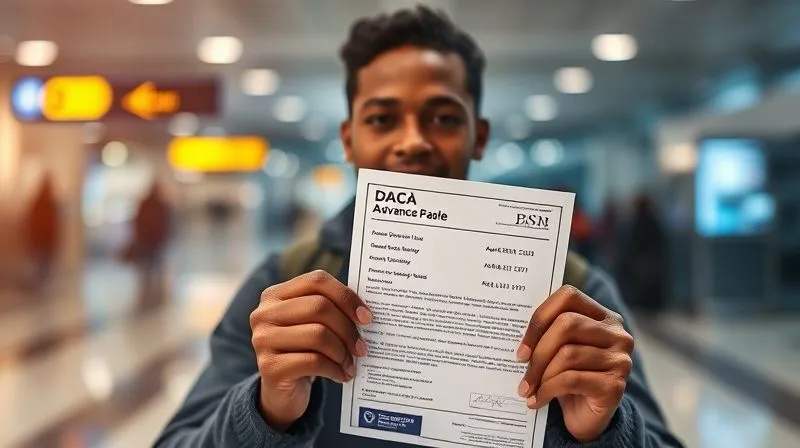
This is where Advance Parole becomes a game-changer for many DACA recipients. Advance Parole (Form I-131) grants permission to an individual who does not have a valid immigrant visa to travel abroad and return to the United States. Crucially, upon return, the individual is "paroled" into the U.S. This parole counts as a "lawful admission" for the purposes of INA §245(a), thereby curing the EWI issue for adjustment of status.
USCIS guidance, reaffirmed multiple times, confirms that a DACA recipient who travels abroad with Advance Parole and is paroled back into the U.S. has met the "inspected and admitted or paroled" requirement for adjustment of status. This is a powerful tool, but it must be used strategically and with caution.
Strategic Considerations for Advance Parole Travel:
- Purpose of Travel: While USCIS has broad discretion, DACA recipients generally must demonstrate an educational, humanitarian, or employment purpose for travel. Common reasons include attending a family member's funeral, visiting a sick relative, participating in academic programs, or attending work-related conferences.
- Duration of Travel: Keep travel brief and purposeful. Long, unexplained trips could raise questions.
- Potential Risks: Despite having Advance Parole, there is always a minimal risk of being denied re-entry, especially if there are other underlying inadmissibility issues (e.g., criminal history, certain immigration violations). Always consult with an experienced attorney before traveling.
- Document Everything: Maintain meticulous records of your Advance Parole application, approval, and travel documents (stamps, boarding passes).
Navigating the 245(i) Exception: A Lifeline for Some
For those DACA recipients who cannot or choose not to pursue Advance Parole, or for whom travel abroad poses too great a risk, INA §245(i) offers another potential pathway. This is a critical provision that allows certain individuals who would otherwise be barred from adjusting status due to an unlawful entry or other immigration violations to do so within the U.S.
To qualify for 245(i), an individual must be the beneficiary of a qualifying visa petition (Form I-130, I-140, or I-360) or labor certification that was filed on or before April 30, 2001. If the petition was filed between January 15, 1998, and April 30, 2001, the applicant must also demonstrate "physical presence" in the U.S. on December 21, 2000. This is a highly specific and often complex requirement.
Key Elements of 245(i) Eligibility:
- Qualifying Petition: The foundational requirement is a valid visa petition or labor certification filed by the deadline. This could have been filed by a parent, spouse, or employer many years ago.
- "Grandfathered" Status: Once a person is "grandfathered" under 245(i), they generally retain that benefit, even if the original petition is no longer viable, as long as a new qualifying petition is filed.
- Penalty Fee: Individuals adjusting under 245(i) must pay a $1,000 penalty fee in addition to the standard I-485 filing fees.
- Current Eligibility: Even if grandfathered, the individual must still be currently eligible for an immigrant visa (e.g., have an approved I-130 and a current priority date).
Locating old petitions can be challenging, often requiring requests for records from USCIS or the National Archives. This is where diligent legal counsel and client cooperation are essential. For more detailed information on 245(i), I often refer to official USCIS guidance and relevant Board of Immigration Appeals (BIA) decisions which clarify its application. USCIS Policy Manual on Adjustment of Status
The Waiver Conundrum: I-601A and its Limitations for DACA
Many clients, upon hearing of inadmissibility, immediately think of waivers. While waivers like the I-601A Provisional Unlawful Presence Waiver are crucial tools in immigration law, their application for DACA recipients with prior entries seeking adjustment of status is often misunderstood, especially concerning the "lawful admission" requirement.
The I-601A waiver addresses only unlawful presence, allowing certain individuals to waive the 3- or 10-year bars to re-entry before departing the U.S. for consular processing. However, it does NOT cure the initial "entered without inspection" issue that prevents adjustment of status within the U.S. If a DACA recipient is EWI and has no 245(i) eligibility or Advance Parole, an I-601A waiver alone will not allow them to adjust status here.
When Waivers Are Relevant for DACA Recipients:
- Consular Processing: If a DACA recipient is EWI, does NOT have 245(i), and cannot get Advance Parole (or prefers consular processing), they might need to leave the U.S. to obtain their immigrant visa. In such a scenario, if they have accrued unlawful presence, an I-601A waiver would be necessary to overcome the unlawful presence bar upon their return. This path is riskier and often less desirable than adjustment of status within the U.S.
- Other Inadmissibility Grounds: If a DACA recipient has a lawful admission (e.g., through Advance Parole) but has other inadmissibility grounds (e.g., certain criminal convictions, misrepresentations), they might need to apply for a different type of waiver (e.g., I-601) concurrently with their I-485.
It's vital to differentiate between the "lawful admission" requirement for adjustment and the "unlawful presence bars" that waivers address. They are distinct legal hurdles.
Strategic Pointers for Various Prior Entry Scenarios
Each DACA recipient's journey is unique, and their prior entry history dictates the best strategy. Here’s a breakdown of common scenarios and my recommended approaches:
Scenario 1: EWI, No Prior Advance Parole, No 245(i) Eligibility
This is the most common and challenging scenario. The primary and often only viable path for adjustment of status is obtaining Advance Parole. The client must identify a compelling reason for travel (educational, humanitarian, employment-related) and apply for Advance Parole. Upon successful return to the U.S. on parole, they will have the requisite "lawful admission" to file an I-485 based on an approved family or employment petition.
Scenario 2: EWI, Has 245(i) Eligibility
If a DACA recipient is "grandfathered" under 245(i), they can proceed with adjustment of status without needing Advance Parole, provided they have an underlying qualifying petition (e.g., an approved I-130) and pay the $1,000 penalty fee. This is often the most straightforward path for those who qualify, as it avoids international travel.
Scenario 3: EWI, Prior Advance Parole Travel and Paroled Entry
If a DACA recipient previously traveled abroad with Advance Parole and was paroled back into the U.S., they have already met the "lawful admission" requirement. They can proceed with filing their I-485 once their priority date is current and they have an approved immigrant visa petition.
Scenario 4: Lawful Entry (e.g., Visa), Overstayed, Now DACA
These cases are generally simpler. If the individual had a lawful admission (e.g., entered on a visa), even if they overstayed, they generally meet the "inspected and admitted" requirement for adjustment of status. They would still need an approved immigrant visa petition and a current priority date, but the prior entry hurdle is typically not an issue. The overstay itself is usually forgiven for immediate relatives of U.S. citizens or certain employment-based categories.
," and "Lawful Entry." The flowchart should be clear and professional, using positive colors. 8K, cinematic lighting, sharp focus, depth of field. Professional photography.")
Gathering Comprehensive Evidence: A Non-Negotiable Step
Regardless of the chosen pathway, thorough documentation is the bedrock of a successful adjustment of status application. I cannot stress this enough. USCIS adjudicators rely entirely on the evidence presented to them.
Essential Documentation Checklist:
- Proof of Lawful Admission/Parole: I-94 records, passport stamps, Advance Parole documents, parole stamps.
- Proof of DACA Status: EAD cards, approval notices (I-797).
- Proof of Qualifying Relationship: Marriage certificates, birth certificates, adoption decrees, I-130 approval notices.
- Financial Support: Affidavits of Support (I-864) from petitioner and any joint sponsors, tax returns, employment letters.
- Identity and Biographic Information: Birth certificate, passport, national identity documents.
- Medical Examination: Sealed I-693 report from a USCIS-approved civil surgeon.
- Police Clearances/Criminal Records: If applicable, certified disposition records for any arrests or convictions.
- 245(i) Evidence: If applicable, proof of the qualifying petition or labor certification filed on or before April 30, 2001, and evidence of physical presence in the U.S. on December 21, 2000.
Organizing these documents systematically, often in a well-indexed binder, significantly aids the adjudicator and can prevent Requests for Evidence (RFEs) that delay processing. As Forbes contributor and legal analyst, Adam S. Gordon, often highlights, "In immigration, meticulous preparation isn't just a best practice; it's a necessity." Forbes Advisor - Immigration Law
Common Pitfalls and How to Avoid Them
Even with a clear strategy, certain missteps can derail an otherwise strong case. I've seen these mistakes countless times, and they are almost always avoidable with careful planning and expert guidance.
Pitfall 1: Misunderstanding "Lawful Admission"
As discussed, DACA grants lawful presence, not lawful admission. Assuming that DACA status alone cures the EWI issue is a critical error. Always verify the basis of admission.
Pitfall 2: Traveling Without Advance Parole or With Expired AP
Departing the U.S. without a valid Advance Parole document while a DACA recipient is generally considered self-deportation and can trigger severe bars to re-entry. Always ensure AP is approved and valid for the entire travel period.
Pitfall 3: Undisclosed Criminal History or Other Inadmissibility Grounds
Attempting to conceal or downplay past criminal issues or other grounds of inadmissibility (e.g., misrepresentation, certain health-related issues) is a grave mistake. Full disclosure to your attorney allows for proper assessment and, if possible, a waiver application. USCIS has access to extensive databases, and attempting to hide information will almost certainly lead to a denial and potentially more severe consequences.
Pitfall 4: Insufficient Documentation for 245(i)
Proving 245(i) eligibility, especially the physical presence requirement for post-1998 petitions, requires robust evidence. Failing to provide utility bills, school records, medical records, or other verifiable documents demonstrating presence on the specific date can lead to denial.
| Pitfall | Impact | Prevention |
|---|---|---|
| Misinterpreting Lawful Admission | I-485 Denial due to EWI | Consult attorney, understand DACA vs. Parole distinction. |
| Traveling Without Advance Parole | Self-deportation, 3/10-year bar | Always secure valid AP before travel. |
| Undisclosed Criminal History | Denial, potential fraud charges | Full disclosure to attorney, explore waivers. |
| Insufficient 245(i) Proof | Loss of 245(i) benefit | Gather extensive historical documentation. |
Case Study: Maria's Path to Permanent Residency
How Strategic Advance Parole Cured Her EWI Issue
Maria, a DACA recipient, entered the U.S. without inspection as a 5-year-old. She had lived in the U.S. for over 20 years, graduated college, and was married to a U.S. citizen. Despite her marriage, her EWI status prevented her from adjusting status under INA §245(a). She also did not qualify for 245(i) as no petition had been filed for her before 2001.
After consulting with me, we identified Advance Parole as her most viable option. Maria's grandmother in Mexico was gravely ill, providing a strong humanitarian reason for travel. We prepared and filed her Form I-131, detailing the humanitarian need and providing supporting documentation (doctor's letters, family affidavits).
Her Advance Parole was approved. Maria traveled to Mexico to visit her grandmother, staying for a week. Upon her return, she presented her Advance Parole document at the port of entry and was paroled into the U.S. This crucial step provided her with the "lawful admission" necessary for adjustment.
With her "lawful admission" now established, we proceeded to file her I-485, based on her U.S. citizen spouse's I-130 petition. The application was approved, and Maria successfully received her green card. This case exemplifies how strategic use of Advance Parole can transform an otherwise impossible adjustment of status case for DACA recipients with prior entries into a successful one.
Frequently Asked Questions (FAQ)
Question: Can I adjust status if I have DACA but also a prior deportation order? No, a prior order of deportation or removal generally makes an individual inadmissible and ineligible for adjustment of status. DACA does not negate a prior removal order. In such complex cases, the removal order would first need to be terminated or reopened and rescinded, which is an extremely challenging legal process requiring specialized expertise. This typically involves filing a motion to reopen with the immigration court or the Board of Immigration Appeals.
Question: What if my Advance Parole application is denied? Can I reapply? Yes, if your Advance Parole application is denied, you can generally reapply, addressing the reasons for the denial. However, it's crucial to understand why it was denied. Was the reason for travel insufficient? Was there an underlying inadmissibility issue? Consulting with an attorney to review the denial notice and strategize a stronger reapplication is highly recommended before refiling.
Question: Does marrying a U.S. citizen automatically solve my EWI problem if I have DACA? No, marrying a U.S. citizen does not automatically solve the "entered without inspection" problem for DACA recipients seeking adjustment of status. While it provides the qualifying petition (Form I-130) necessary for a green card, the EWI issue still means you lack a "lawful admission" for adjustment under INA §245(a). You would still need to either qualify for 245(i) or obtain Advance Parole and be paroled back into the U.S. to cure the EWI issue.
Question: How long does the Advance Parole process typically take for DACA recipients? Processing times for Advance Parole (Form I-131) can vary significantly based on USCIS workload and service center. Historically, it can range from 6 to 12 months, and sometimes longer. It's essential to check the most current USCIS processing times online. Due to these varying times, it's crucial to apply well in advance of any planned travel.
Question: What kind of documentation is needed to prove "physical presence" for 245(i) if my petition was filed between 1998-2001? Proving physical presence on December 21, 2000, requires concrete evidence. Acceptable documents include utility bills in your name (or parents' name if you were a minor), school records (transcripts, report cards), medical records, employment records (pay stubs, W-2s), bank statements, and even dated photographs with verifiable context. The more evidence, the stronger the claim. It's about establishing a clear nexus to the U.S. on that specific date.
Key Takeaways and Final Thoughts
Navigating DACA adjustment of status issues for clients with prior entries is undoubtedly one of the most intricate areas of immigration law. Yet, as an experienced practitioner, I can assure you that pathways to permanent residency genuinely exist for many DACA recipients, provided the correct legal strategies are employed.
- Advance Parole is a Cornerstone: For most EWI DACA recipients without 245(i) eligibility, strategic use of Advance Parole is the most direct route to curing the "lawful admission" requirement.
- 245(i) Remains a Lifeline: For those "grandfathered" under 245(i), this provision offers an invaluable opportunity to adjust status without leaving the U.S.
- Knowledge is Power: Understanding the distinction between "lawful presence" and "lawful admission" is fundamental.
- Documentation is Everything: Meticulous record-keeping and comprehensive evidence are non-negotiable for success.
- Avoid Common Pitfalls: Be aware of the risks of international travel without proper authorization and the importance of full disclosure.
This journey demands not just legal knowledge, but also careful planning, diligent execution, and often, a degree of patience. My hope is that this guide empowers you with the insights to confidently pursue the path to permanent residency for yourself or your clients. Remember, every case is unique, and personalized legal counsel is always your best asset in achieving this life-changing goal.
American Immigration Lawyers Association (AILA) is an excellent resource for finding qualified legal professionals in this field.Recommended Reading
- Certificate Rejected? 7 Steps When Your Client's Credit Counseling Fails
- Rectify Past Corporate Tax Errors: A 7-Step Expert Framework
- Unlock Rapid Revenue: 7 Proven Strategies for Underutilized IP Assets
- 7 Steps: Legally Preserving Digital Evidence After a Cyberattack
- Revocation Notice? 7 Steps to Fight Unfair Administrative Permit Decisions




Comments
Leave a comment below. Your email will not be published. Required fields marked with *