


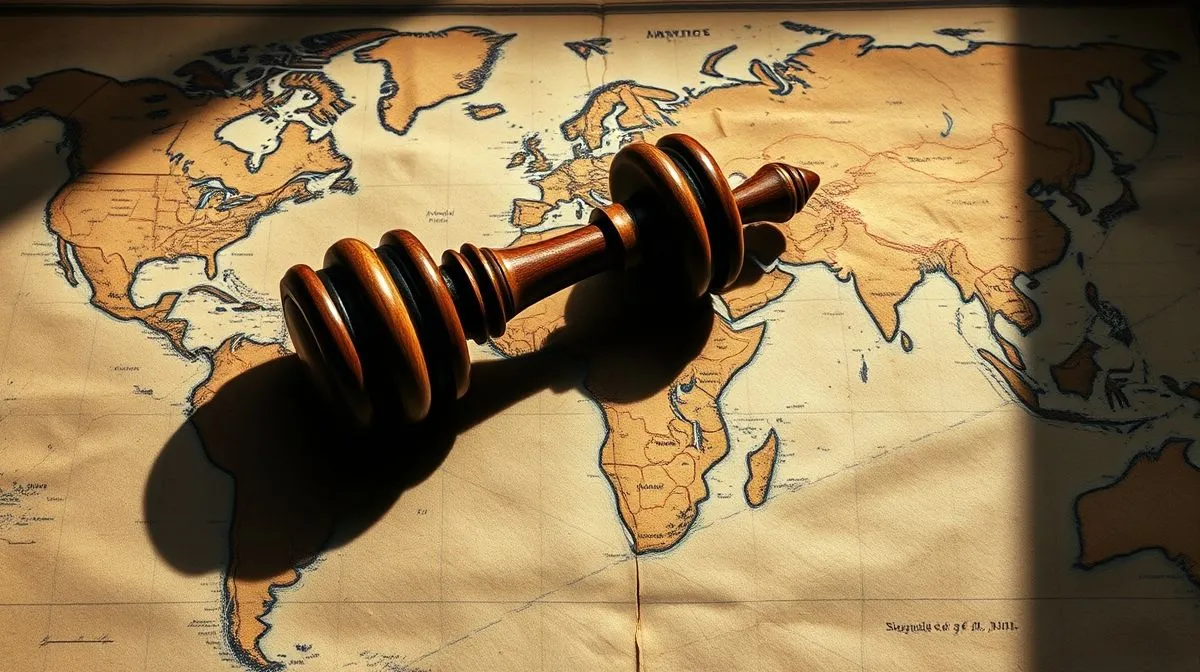
Imagine a world where the most egregious crimes go unpunished, where nations flout agreements with impunity, and where justice, though declared, remains an elusive phantom. This isn't a dystopian novel; it's often the stark reality facing the international legal system when it comes to the enforcement of court rulings. Unlike domestic legal frameworks, which boast robust police forces and binding executive powers, international law operates in a vastly different, more fragmented arena.
The core problem lies in the very nature of international relations: a system built on sovereign states, each fiercely guarding its independence. This inherent tension between national sovereignty and the imperative of global justice creates a complex web of obstacles that can render even the most meticulously reasoned judgments toothless. The question isn't whether international courts deliver justice, but rather, what happens when their pronouncements are met with defiance?
In this comprehensive guide, we will delve deep into the multifaceted answers to the question: what are the challenges enforcing international court rulings? We'll explore the fundamental hurdles, from the absence of a global enforcement body to the intricate dance of geopolitical power, and examine real-world examples that underscore these difficulties. By the end, you'll gain a profound understanding of why international justice, while vital, remains a constant struggle for effective implementation.
The Foundations of International Justice: A Lofty Ideal Meets Harsh Reality
Before dissecting the challenges, it's crucial to understand the landscape of international justice. International courts and tribunals, such as the International Court of Justice (ICJ), the International Criminal Court (ICC), and regional human rights courts like the European Court of Human Rights (ECtHR), serve as crucial pillars for upholding international law.
What are International Court Rulings?
These rulings are authoritative decisions issued by international judicial bodies concerning disputes between states, individuals, or other international actors. They interpret treaties, customary international law, and general principles of law, aiming to resolve conflicts, hold perpetrators accountable, and clarify legal obligations. For instance, the ICJ settles legal disputes submitted to it by states and gives advisory opinions on legal questions referred to it by authorized UN organs and specialized agencies. Learn more about the ICJ's role on its official website.
The Principle of Pacta Sunt Servanda
At the heart of international law lies the principle of pacta sunt servanda – agreements must be kept. This foundational tenet suggests that states are obligated to comply with treaties they've ratified and, by extension, with rulings from courts they've agreed to be bound by. However, the theoretical obligation often collides with practical realities, leading to significant enforcement gaps.
State Sovereignty: The Ultimate Hurdle to Enforcement
Perhaps the most formidable obstacle to the enforcement of international court rulings is the deeply entrenched principle of state sovereignty. Each state is considered supreme within its own territory, free from external control. This doctrine, while essential for national self-determination, directly conflicts with the notion of a higher authority dictating a state's actions.
National Interest vs. Global Justice
When an international court ruling clashes with a state's perceived national interest, economic priorities, or political stability, the temptation to disregard the judgment can be overwhelming. States often prioritize their immediate domestic concerns over long-term compliance with international legal obligations, particularly if the ruling demands significant financial reparations, territorial concessions, or the extradition of high-ranking officials.
The Absence of a Global Enforcement Body
Unlike national systems, there is no international police force or executive branch capable of coercing states into compliance. The international legal system relies heavily on voluntary adherence, diplomatic pressure, and, in extreme cases, collective security measures authorized by bodies like the UN Security Council. This structural weakness means that a state determined to defy a ruling often faces limited direct consequences, particularly if it is a powerful nation.
The Geopolitical Landscape: Power, Politics, and the Veto
Beyond sovereignty, the exercise of geopolitical power significantly influences the enforceability of international judgments. The political will of powerful states, or lack thereof, can make or break an enforcement effort.
The UN Security Council's Role and Limitations
The United Nations Security Council (UNSC) is the only body with the authority to mandate binding actions, including sanctions or military intervention, to ensure compliance with international law. However, its effectiveness is severely curtailed by the veto power held by its five permanent members: China, France, Russia, the United Kingdom, and the United States. If a ruling affects the interests of one of these powers or their allies, a veto can effectively block any enforcement action, leaving the judgment unenforced and the court's authority undermined.
Diplomatic Pressure and Sanctions: Tools and Their Limits
In cases where direct enforcement is impossible, diplomatic pressure, reputational damage, and targeted sanctions become the primary tools. While these can be effective in some instances, their success depends on the collective will of the international community and the target state's vulnerability. Sanctions, for example, can be slow-acting, harm civilian populations, and may not always compel a defiant regime to change course.
Compliance Mechanisms and Their Weaknesses
Even when states do not outright defy rulings, the mechanisms for compliance are often weak, slow, or indirect, contributing to the challenges enforcing international court rulings.
Voluntary Compliance and Reputational Costs
The most common form of compliance is voluntary. States often adhere to rulings to maintain their international reputation, foster good relations, and uphold the rule of law, which benefits them in other areas. However, for states that care less about their standing or face severe domestic pressure, reputational costs alone may not be sufficient incentive.
Reciprocity and Self-Help Measures
In some instances, states may resort to 'self-help' measures, such as retaliation or reciprocal non-compliance, when a ruling against another state is not honored. While technically permissible in some contexts, this can escalate tensions and undermine the very legal order the ruling was meant to uphold. It's a double-edged sword that highlights the fragility of enforcement without a central authority.
Financial and Economic Disincentives
Some international courts, particularly those dealing with economic disputes, can impose financial penalties or order reparations. However, collecting these funds from a non-compliant state often requires further international cooperation, asset freezes, or the seizure of state property abroad, all of which are complex and politically fraught endeavors.
Resource Limitations and Capacity Gaps
Beyond political will and sovereignty, practical limitations also hinder enforcement efforts, particularly for developing nations or in complex humanitarian cases.
Developing Nations and Enforcement Capacity
Many states, especially developing ones, may genuinely lack the administrative, financial, or legal capacity to implement complex international judgments, even if they desire to comply. This might involve legislative changes, institutional reforms, or extensive investigations that are beyond their current capabilities.
The Cost of Justice
Pursuing justice through international courts can be incredibly expensive and time-consuming. The lengthy legal processes, the need for expert legal teams, and the costs associated with monitoring compliance can be prohibitive, especially for smaller nations or non-governmental organizations seeking accountability.
The Domestic Dimension: Legal and Cultural Hurdles
Even when an international ruling is accepted by a state's leadership, its implementation can face significant resistance within the domestic legal and political landscape.
Different Legal Traditions
States operate under diverse legal systems (e.g., common law, civil law). Integrating international judgments into domestic law can be a complex process, requiring legislative amendments, judicial interpretation, and administrative adjustments. This can lead to delays or even outright non-implementation if domestic legal frameworks are not adequately adapted.
Domestic Opposition and Public Opinion
A ruling that is unpopular domestically, perhaps because it challenges deeply held national narratives, historical interpretations, or economic interests, can face strong public and political opposition. Leaders might fear political backlash or even regime instability if they are perceived as capitulating to external pressure, making compliance a politically risky endeavor.
Navigating the Enforcement Labyrinth: Case Studies
Examining specific instances where international court rulings have faced enforcement challenges provides invaluable insight into the complexities involved.
Nicaragua v. United States (ICJ, 1986)
One of the most famous examples of an unenforced ICJ ruling is the 1986 case where the Court found the United States had violated international law by supporting the Contras in Nicaragua. The U.S. rejected the ICJ's jurisdiction and refused to comply with the judgment, effectively illustrating that even powerful states can disregard international court decisions without immediate, direct repercussions. This case profoundly highlighted the limitations of the ICJ's enforcement powers without UNSC backing.
Russia v. Georgia (ECtHR, 2021)
More recently, the European Court of Human Rights ruled against Russia concerning human rights violations during and after the 2008 conflict with Georgia. While the ECtHR's judgments are legally binding on member states of the Council of Europe, Russia's subsequent withdrawal from the Council of Europe in 2022, following its invasion of Ukraine, further complicated the enforceability of this and other past rulings, demonstrating how political actions can undermine judicial authority.
ICC Warrants: Sudan and Libya
The International Criminal Court has issued arrest warrants for high-profile individuals, including former Sudanese President Omar al-Bashir and Libyan leader Muammar Gaddafi (deceased). Despite these warrants, their actual arrest and transfer to The Hague have often been hampered by states' unwillingness to cooperate, citing sovereignty or political reasons. This illustrates the ICC's reliance on state cooperation for the execution of its mandates, and the significant challenges enforcing international court rulings when that cooperation is absent.
Pathways to Stronger Enforcement: A Glimmer of Hope?
Despite the formidable obstacles, the international community continues to seek ways to strengthen the enforceability of international judgments. Progress, though often incremental, is being made through various avenues.
Strengthening International Institutions
Efforts to reform the UN Security Council, limit the use of the veto in cases of mass atrocities, and enhance the powers of other international bodies could potentially lead to more robust enforcement mechanisms. Greater cooperation between international courts and regional organizations can also create more localized pressure for compliance.
Role of Civil Society and Non-State Actors
Non-governmental organizations (NGOs), human rights groups, and a vigilant international media play a critical role in monitoring compliance, naming and shaming non-compliant states, and mobilizing public opinion. This 'soft power' can exert significant pressure, making it harder for states to ignore their international obligations without facing reputational and political costs.
Incremental Progress and Norm Development
Over time, consistent jurisprudence from international courts contributes to the development of stronger international norms and customary law. Even when specific rulings are not immediately enforced, they contribute to a growing body of legal precedent that shapes future state behavior and gradually strengthens the international legal order. The long game of international law is one of persistent norm-building and the slow, often painful, accumulation of precedents.
Frequently Asked Questions (FAQ)
What is the main reason international court rulings are hard to enforce? The primary challenge is state sovereignty, as there's no global enforcement body to compel states to comply against their will, especially when a ruling conflicts with their national interests.
Does the UN Security Council enforce ICJ rulings? Yes, the UN Security Council can be called upon to enforce ICJ rulings, but its power is limited by the veto power of its five permanent members, which can block any enforcement action.
Are all international court rulings legally binding? Yes, rulings from international courts like the ICJ, ICC, and ECtHR are legally binding on the parties involved, provided those parties have accepted the court's jurisdiction. The challenge lies in their practical enforcement.
What happens if a country ignores an international court ruling? If a country ignores a ruling, it may face diplomatic pressure, reputational damage, economic sanctions, or even reciprocal measures from other states. However, direct coercive enforcement is rare and difficult to achieve.
Can individuals be held accountable by international courts? Yes, courts like the International Criminal Court (ICC) can hold individuals accountable for grave international crimes, though their ability to arrest and prosecute relies heavily on the cooperation of member states.
Recommended Reading
- Green Card Denial After Approval? What You Need to Know!
- Unlock Justice: The Ultimate Guide to How to Apply for Legal Aid for Family Court Matters
- Unlock Your Innovation: Can You Patent an Idea Without a Working Prototype?
- Unveiling the Truth: When Can an Employer Deny FMLA Leave Eligibility?
- Online Scam Victim? What To Do After Falling For It (2024 Guide)
Conclusion
The question of what are the challenges enforcing international court rulings reveals a complex interplay of legal principles, political realities, and practical limitations. From the fundamental hurdle of state sovereignty and the absence of a global enforcement mechanism to the intricate dynamics of geopolitical power and the domestic resistance to international judgments, the path to justice on the global stage is fraught with obstacles. Yet, despite these formidable challenges, international courts continue to play an indispensable role in defining, interpreting, and promoting the rule of law. Their judgments, even when unenforced, contribute to a vital legal framework that shapes state behavior, fosters accountability, and serves as a beacon for a more just and orderly world. The struggle for effective enforcement is ongoing, a testament to the enduring tension between the ideal of universal justice and the fragmented reality of international relations, but it is a struggle worth continuing for the sake of global peace and human rights.




Comments
Leave a comment below. Your email will not be published. Required fields marked with *