


What if F-1 Student's SEVIS Record is Terminated Incorrectly by DSO?
For over two decades in immigration law, I've witnessed firsthand the sheer panic and devastating consequences that an F-1 student faces when their SEVIS record is terminated. It's an immediate, gut-wrenching moment that can derail academic dreams and jeopardize one's legal status in the United States.
But what happens when that termination isn't due to your fault, but an administrative oversight or mistake by your Designated School Official (DSO)? This incorrect termination of an F-1 student's SEVIS record is a nightmare scenario, often leaving students feeling helpless, confused, and fearing deportation.
In this comprehensive guide, I'll draw upon my extensive experience to provide you with a clear, actionable roadmap. We'll explore the immediate steps to take, how to diagnose the error, the critical documentation required, and the various pathways to reinstatement, ensuring you're equipped with the expert insights needed to navigate this challenging situation and protect your future.
Understanding the SEVIS System and Your F-1 Status
Before diving into solutions, it's crucial to grasp the ecosystem you're operating within. The Student and Exchange Visitor Information System (SEVIS) is the backbone of the F-1 student visa program, an internet-based system that U.S. government agencies use to maintain information on nonimmigrant students and exchange visitors.
The Pivotal Role of the DSO
Your Designated School Official (DSO) is your primary point of contact and, arguably, your most important ally within this system. DSOs are university staff members authorized by the U.S. Department of Homeland Security (DHS) to access SEVIS and manage student records. They certify your enrollment, authorize practical training, update personal information, and, critically, can terminate your record.
A DSO's role is complex, requiring them to be well-versed in intricate immigration regulations. While most DSOs are diligent and supportive, human error, miscommunication, or an incomplete understanding of specific circumstances can sometimes lead to incorrect actions, including the termination of an F-1 student's SEVIS record.
Common Reasons for SEVIS Termination (and Why Incorrect Ones Occur)
SEVIS records are typically terminated for legitimate reasons such as failure to enroll, unauthorized employment, withdrawal from studies, or completion of a program. However, an incorrect termination often stems from:
- Administrative Errors: Data entry mistakes, misinterpretation of student status changes, or accidental clicks within the SEVIS system.
- Communication Breakdown: A student informs a department, but the information doesn't reach the DSO in time, or vice-versa.
- Misunderstanding of Regulations: Less common, but a DSO might misinterpret a specific regulation, leading to an unwarranted termination.
- Timing Issues: Delays in processing extensions, transfers, or OPT applications can sometimes lead to automated terminations if not managed proactively.
Recognizing the potential for these errors is the first step in understanding that an incorrect termination is not necessarily your fault, and more importantly, it is often fixable.
Immediate Steps: What to Do Within the First 24-48 Hours
When you discover your F-1 student's SEVIS record is terminated incorrectly by DSO, time is of the essence. Procrastination can severely limit your options. Here’s what you must do immediately:
- Contact Your DSO Immediately: This is your absolute first priority. Schedule an urgent meeting or call. Do not rely solely on email for initial contact, but follow up all conversations with an email summary for your records. Clearly explain that you believe the termination is incorrect and ask for clarification.
- Gather All Relevant Documentation: Collect every piece of paper or digital record that supports your claim of maintaining status. This includes:
- I-20 forms (all of them)
- Passport and visa stamp
- I-94 admission record (Check your I-94 here)
- Transcripts and proof of enrollment
- Proof of financial support
- Any communication with your university about your status, enrollment, or leaves of absence.
- Avoid Panic, But Act Decisively: While the situation is stressful, maintaining a clear head will help you articulate your case effectively. However, do not delay. Every day counts.
- Seek Initial Expert Advice: Even before fully understanding the cause, a brief consultation with an experienced immigration attorney can provide invaluable guidance on your rights and immediate next steps. They can help you understand the severity and potential pathways.

Diagnosing the Error: Was it Truly Incorrect?
Once you've contacted your DSO, the next critical phase is to understand *why* the termination occurred and to verify if it was indeed incorrect. This requires a thorough review of your record and the circumstances surrounding the termination.
Reviewing Your SEVIS Record Details
Your DSO has access to your full SEVIS record and should be able to show you the reason for termination coded in the system. Common codes might be 'Completed Program,' 'Authorized Early Withdrawal,' 'Unauthorized Withdrawal,' or 'Failure to Enroll.' If the reason coded does not align with your understanding of your status, you have a strong case for an incorrect termination.
Ask your DSO to walk you through the SEVIS notes related to your record. Sometimes, an internal note or a specific date entry might reveal the source of the error. Be polite but persistent in requesting this information.
Identifying Discrepancies and Evidence
Compare the termination reason with your own records. For example:
- If terminated for 'Failure to Enroll,' but you have tuition receipts and class schedules, that's a clear discrepancy.
- If terminated for 'Unauthorized Employment,' but you only worked under approved OPT or CPT, you have documentation to prove it.
- If terminated during a period you believed you were on an authorized leave of absence, present the university's approval for that leave.
The more specific evidence you can provide, the stronger your argument that your F-1 student's SEVIS record was terminated incorrectly by DSO. This evidence is your shield and sword in the reinstatement battle.
The Reinstatement Process: A Step-by-Step Guide
Once you've established that the termination was incorrect, there are generally three main avenues for reinstatement, depending on the nature of the error and the time elapsed. Navigating these requires precision and expert guidance.
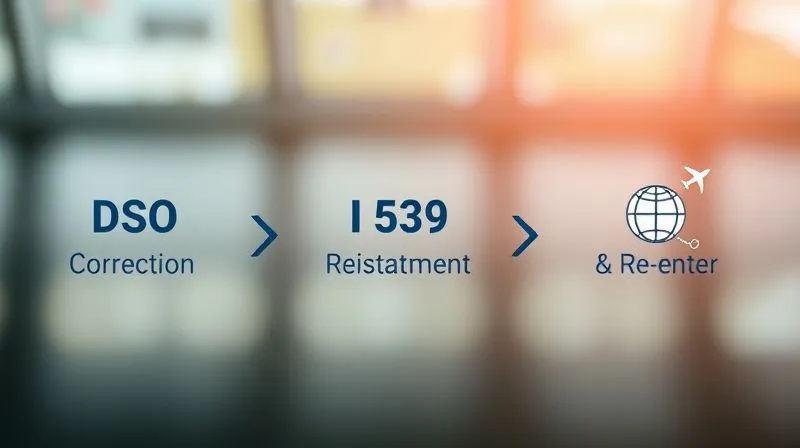
- DSO Correction (Data Fix): If the termination was a clear administrative error by the DSO and discovered very quickly (often within 30-60 days), the DSO might be able to request a 'data fix' from SEVP (Student and Exchange Visitor Program). This is the simplest and fastest resolution, as it corrects the record directly within SEVIS. Your DSO must provide a detailed explanation and evidence to SEVP.
- Filing Form I-539, Application to Extend/Change Nonimmigrant Status: This is the most common route for reinstatement if a data fix isn't possible, or if more time has passed since the incorrect termination. You must file this application with USCIS. To be eligible, you generally must:
- Not have been out of status for more than 5 months (though exceptions exist for circumstances beyond your control).
- Not have a record of repeated or willful violations of USCIS regulations.
- Be pursuing, or intend to pursue, a full course of study at a SEVP-approved school.
- Not have engaged in unauthorized employment.
- Demonstrate that the violation of status resulted from circumstances beyond your control (e.g., the DSO's incorrect termination).
- Departing the U.S. and Re-entering with a New I-20: In some cases, particularly if the 5-month window for I-539 has passed, or if there are other complexities, leaving the U.S., obtaining a new I-20 from your school, and applying for a new F-1 visa at a U.S. consulate abroad may be a viable, albeit more disruptive, option. This should only be considered after careful consultation with an immigration attorney.
| Option | Eligibility | Process | Timeline | Risk |
|---|---|---|---|---|
| DSO Correction (Data Fix) | Clear DSO error, discovered quickly (approx. <60 days) | DSO contacts SEVP directly | Days to weeks | Low, if error is clear |
| Form I-539 Reinstatement | Out of status <5 months, no willful violations, circumstances beyond control | Student files with USCIS | Months (6-18+) | Moderate, requires strong evidence |
| Depart & Re-enter | Can obtain new I-20 & visa, no bars to admissibility | Leave U.S., apply for new visa abroad | Weeks to months | Moderate, potential for visa denial |
Building Your Case: Essential Documentation and Evidence
Regardless of the reinstatement pathway, the strength of your case hinges on compelling documentation. This is where you demonstrate that your F-1 student's SEVIS record was terminated incorrectly by DSO and that you deserve reinstatement.
- New I-20 with Reinstatement Request: Your DSO must issue a new I-20 with a specific notation indicating that it's for a reinstatement application.
- Financial Proof: Bank statements, sponsorship letters, scholarship awards demonstrating sufficient funds for your entire program of study.
- Academic Transcripts: Official transcripts showing continuous enrollment and good academic standing.
- Letter from Your DSO: A detailed letter from your DSO explaining the incorrect termination, confirming your enrollment, and recommending reinstatement. This is perhaps the single most crucial piece of evidence.
- Personal Statement/Affidavit: Your narrative explaining the circumstances, why you believe the termination was incorrect, and your commitment to your studies.
- Copies of All Prior I-20s, Visa Stamps, Passport, and I-94.
- Any other supporting documents: Emails, medical records (if applicable for a leave), university official letters, etc.
Crafting a Compelling Personal Statement
Your personal statement is your voice to USCIS. It should be:
- Clear and Concise: Explain the facts logically and chronologically.
- Empathetic and Honest: Acknowledge the seriousness of the situation but emphasize your innocence.
- Well-Supported: Reference specific documents you've included in your application.
- Focused on 'Beyond Your Control': This is the legal standard. You must explain how the termination was due to circumstances you could not reasonably prevent.
Case Study: How Maria Reinstated Her F-1 Status
Maria, an F-1 student, was shocked to find her SEVIS record terminated for 'Failure to Enroll' just weeks before her final semester. She had, in fact, been fully enrolled and attending classes. Upon investigation with her DSO, it was discovered that a clerical error had occurred during a system migration, causing her enrollment data to be incorrectly linked to an inactive record. Her DSO immediately acknowledged the error, provided a detailed letter explaining the mistake, and issued a new I-20 for reinstatement. Maria, with the help of an immigration attorney, promptly filed her I-539 application, including her transcripts, financial proof, and a personal statement outlining the administrative error. Within six months, her reinstatement was approved, allowing her to complete her degree without interruption. This case highlights the power of immediate action and strong documentation when an F-1 student's SEVIS record is terminated incorrectly by DSO.
Navigating Potential Pitfalls and Delays
Even with a strong case, the immigration process can be fraught with challenges. Understanding these potential pitfalls can help you prepare and mitigate risks.
“In immigration matters, proactive engagement and meticulous documentation are not just best practices; they are necessities. Assume nothing, verify everything, and always maintain clear communication with your DSO and legal counsel.”
The Importance of Legal Counsel
While you can file an I-539 application yourself, the complexities of reinstatement, especially when an F-1 student's SEVIS record is terminated incorrectly by DSO, often warrant expert legal assistance. An immigration attorney can:
- Help you understand the nuances of your specific situation and eligibility.
- Assist in gathering and organizing documentation.
- Draft compelling arguments and personal statements.
- Communicate with USCIS or SEVP on your behalf.
- Advise on maintaining status during the long processing times.
As the American Immigration Lawyers Association (AILA) frequently emphasizes, the immigration landscape is constantly evolving, making professional guidance invaluable.
Maintaining Status During the Process
If you have filed an I-539 application for reinstatement, you are generally considered to be in a 'period of authorized stay' while the application is pending. This means you are not accumulating unlawful presence, but you are not considered to be in F-1 status either. During this time:
- You cannot work (unless you had prior authorization that continues to be valid).
- You must continue to attend school and maintain a full course load.
- You should avoid travel outside the U.S. as it could be considered abandonment of your I-539 application.
What to Do If Reinstatement is Denied
While disheartening, a denial of reinstatement is not necessarily the end of the road, especially if your F-1 student's SEVIS record was terminated incorrectly by DSO. It's crucial to understand your options.
Appeals and Alternative Options
- Motion to Reopen or Reconsider: If you believe USCIS made a legal or factual error, or if new evidence has become available, your attorney can file a Form I-290B, Notice of Appeal or Motion. This must be done within a strict timeframe.
- New F-1 Visa Application: As mentioned earlier, leaving the U.S. and applying for a new F-1 visa at a consulate abroad is an option. However, you must address the previous termination and denial in your new application, and there might be a risk of visa denial depending on the reasons for the I-539 denial.
- Consult with an Expert: Immediately after a denial, consult your immigration attorney. They can review the denial letter, assess the reasons, and advise on the most strategic next steps, including any potential bars to future admissibility.
Preventing Future Issues: Best Practices for F-1 Students
An ounce of prevention is worth a pound of cure, especially when it comes to your immigration status. While an F-1 student's SEVIS record can be terminated incorrectly by DSO, many issues can be avoided with diligence.
- Regular Communication with Your DSO: Do not hesitate to contact your DSO with any questions about your status, enrollment, or potential changes. Keep them informed of any personal or academic changes that might affect your I-20.
- Understand Your F-1 Regulations: Familiarize yourself with the basic rules of your F-1 status. Ignorance is not an excuse in immigration law. Resources like the Study in the States website by SEVP are invaluable.
- Maintain Impeccable Records: Keep physical and digital copies of every I-20, visa stamp, I-94, academic record, financial document, and communication with your DSO or USCIS.
- Be Proactive: If you anticipate any changes (e.g., changing majors, taking a leave, applying for OPT), discuss them with your DSO well in advance.
| Action | Frequency | Benefit |
|---|---|---|
| Communicate with DSO | Regularly, or with any change | Prevents misunderstandings, ensures record accuracy |
| Review I-20 & I-94 | Every semester, upon entry/re-entry | Catches errors early, confirms status |
| Keep Records Organized | Continuously | Essential for any future applications or issues |
| Understand Regulations | Ongoing | Empowers you to maintain compliance |
| Monitor Email/SEVIS Portal | Weekly | Alerts to any status changes or notifications |
Frequently Asked Questions (FAQ)
Question? How long does the F-1 reinstatement process typically take? The timeline for F-1 reinstatement via Form I-539 can vary significantly, ranging from 6 months to over 18 months, depending on USCIS caseloads, the service center processing your application, and the complexity of your case. A DSO data fix, if applicable, is much faster, often resolved within days or weeks.
Question? Can I continue attending classes while my I-539 reinstatement application is pending? Yes, generally you are expected to continue maintaining a full course of study at your SEVP-approved school while your I-539 reinstatement application is pending with USCIS. This demonstrates your intent to maintain F-1 status and is crucial for your application's approval. However, you cannot engage in any employment, on-campus or off-campus, without specific authorization.
Question? What if my DSO is uncooperative or unresponsive after an incorrect termination? This is a challenging situation. First, escalate the matter within the university's international student office, speaking with a supervisor or the head of the department. If internal avenues fail, seeking immediate legal counsel from an immigration attorney is imperative. An attorney can formally intervene, communicate with the DSO, or advise on alternative strategies to pursue reinstatement directly with USCIS.
Question? Is it always better to file for reinstatement than to leave the U.S. and re-enter with a new I-20? Not always. The 'best' option depends on your specific circumstances. If you have been out of status for more than 5 months, or if there are other complex immigration issues, leaving the U.S. and applying for a new visa might be the only viable option. However, leaving carries the risk of visa denial at the consulate, and you would need a new I-20 from your school. Reinstatement avoids leaving the U.S. but can take a long time. An immigration attorney can help you weigh the pros and cons for your individual case.
Question? What are the potential costs involved in the reinstatement process? Costs typically include the USCIS filing fee for Form I-539 (currently $470), and potentially legal fees if you hire an immigration attorney (which can range significantly based on the attorney's experience and the complexity of your case). There are no fees for a DSO data fix, but your school might charge administrative fees for issuing new I-20s.
Key Takeaways and Final Thoughts
- An incorrect SEVIS termination is a serious issue, but it is often fixable with swift, informed action.
- Your DSO is your primary contact; maintain clear and documented communication.
- Meticulous documentation and a compelling personal statement are vital for any reinstatement application.
- Understand the three pathways: DSO Correction, I-539 Reinstatement, or Depart & Re-enter.
- Legal counsel can significantly enhance your chances of a successful outcome and navigate complexities.
As someone who has guided countless students through the intricacies of immigration law, I can assure you that discovering your F-1 student's SEVIS record was terminated incorrectly by DSO is a daunting experience. However, by staying informed, acting decisively, and leveraging expert advice, you can overcome this hurdle. Your academic future and legal status are paramount; empower yourself with knowledge and the right support to protect them.
Recommended Reading
- SCI Lawsuits: Cracking Future Medical Cost Projections (6 Proven Steps)
- The Antitrust Tsunami: How Law Reshapes Athlete Name, Image, Likeness
- 5 Proven Strategies: Safeguarding Your Business in Family Court Disputes
- Funding Estate Tax on Illiquid Business Assets: 5 Expert Strategies
- FERPA Emergencies: 5 Steps to Lawful Student Record Disclosure


Comments
Leave a comment below. Your email will not be published. Required fields marked with *