



What to do when your government contract is terminated for default?
For over two decades navigating the complex currents of administrative law and government contracts, I've witnessed firsthand the seismic shock a 'Termination for Default' can send through a company. It’s not just a contract loss; it’s a direct assault on reputation, cash flow, and future opportunities. I recall one particularly tough case where a promising small business nearly collapsed under the weight of such a notice, simply because they didn't understand the immediate, critical steps required to protect themselves.
The fear and confusion are palpable. Contractors often feel blindsided, overwhelmed by the dense regulatory language of the Federal Acquisition Regulation (FAR) and the potential financial and reputational fallout. This isn't merely a setback; it's a crisis that demands an immediate, strategic, and informed response. Many mistakenly believe the battle is lost the moment the notice arrives, but in my experience, that couldn’t be further from the truth.
This article isn't just a guide; it's a battle plan forged from years of experience in the trenches of government contracting disputes. We will dissect the anatomy of a default termination, illuminate your rights, and provide you with a definitive, actionable framework to navigate this treacherous landscape. From understanding the nuances of a Cure Notice to mastering the art of appeal, I’ll equip you with the expert insights and strategies needed to protect your business, mitigate damages, and safeguard your future in government contracting. So, if you're asking yourself, "What to do when your government contract is terminated for default?", you've come to the right place.
Understanding the Beast: What is a Termination for Default?
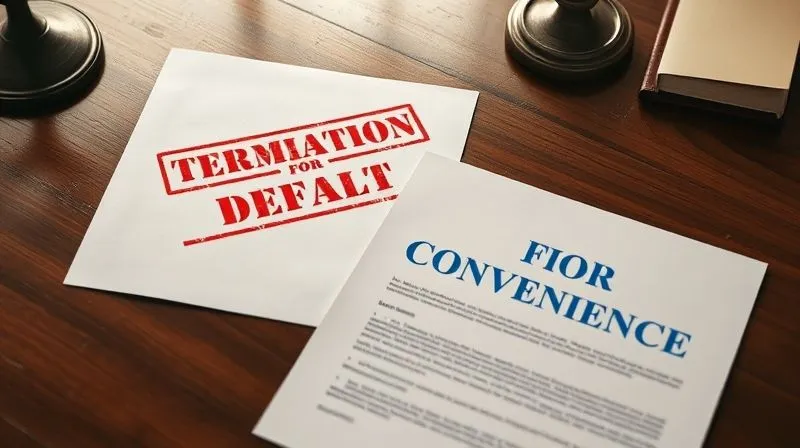
A termination for default, governed primarily by FAR Part 49, Termination of Contracts, is arguably the most severe action the government can take against a contractor. Unlike a termination for convenience, where the government ends the contract because it's no longer in its best interest and typically compensates the contractor for work performed and reasonable settlement expenses, a default termination occurs when a contractor fails to perform according to the contract's terms and conditions.
The implications are far-reaching and potentially devastating. A default termination can lead to the government holding you responsible for excess reprocurement costs – the difference between your contract price and what it costs the government to get the work done by another contractor. It can also severely impact your Contractor Performance Assessment Reporting System (CPARS) ratings, making it incredibly difficult to win future government work. In the most severe cases, it can even lead to debarment or suspension, effectively barring you from federal contracting for a period.
From a contracting officer's perspective, a default termination is a measure of last resort, invoked when a contractor's failure to perform is deemed inexcusable and incurable. It’s a declaration that the contractor has fundamentally breached the agreement. However, as an experienced practitioner, I know that the government's perspective isn't always the full story, and there are often legitimate defenses or mitigating circumstances that can be raised.
"A termination for default is not merely a contract cancellation; it's a judgment against a contractor's performance and reliability, carrying significant financial and reputational baggage that demands an immediate and robust defense."
The Critical First 24-72 Hours: Immediate Actions You Must Take
When that notice arrives, panic is a natural first reaction. However, the clock starts ticking immediately, and your response in the initial hours and days can profoundly influence the outcome. This is where experience truly pays off – knowing precisely where to direct your energy.
Review the Termination Notice Meticulously
Your first step is to read the termination notice with forensic precision. Do not skim. Identify the exact date of issuance, the specific contract clause cited for default (e.g., FAR 52.249-8, Default (Fixed-Price Supply and Service)), and the precise alleged failures in performance. Pay close attention to any deadlines mentioned for response or appeal. This document is the government's opening argument, and understanding its core allegations is paramount to formulating your defense.
Immediately after review, secure expert legal counsel specializing in government contracts. This isn’t a task for a general corporate attorney. You need someone who breathes FAR, understands the nuances of boards of contract appeals, and has a track record in default terminations. Their guidance from day one is invaluable.
Preserve All Relevant Documentation
This cannot be stressed enough: Document, document, document. Assume every piece of communication, every email, every meeting minute, every performance report, and every internal memo related to the contract will be scrutinized. Freeze all data deletion and gather everything. This includes:
- All contract documents, amendments, and modifications.
- Correspondence with the Contracting Officer (CO) and other government personnel.
- Internal project management records, schedules, and progress reports.
- Quality control reports and testing documentation.
- Subcontractor agreements and performance records.
- Financial records related to contract performance.
- Any documentation of excusable delays or government-caused issues.
Creating a centralized, secure repository for these documents is crucial. Your ability to defend against the default will hinge on the evidence you can present, and a disorganized or incomplete record can be fatal to your case.
Notify Key Internal Stakeholders
Communicate internally with your legal team (if not already engaged), finance department, project managers, and senior leadership. Ensure everyone understands the gravity of the situation and the need for a coordinated response. This also helps prevent inadvertent actions that could prejudice your case.
"The initial 72 hours post-default notice are a race against time. Your ability to act swiftly, gather facts, and engage specialized legal expertise will set the foundation for any successful defense or mitigation strategy."
Here’s an immediate action checklist to guide your first steps:
| Action Item | Timeline | Responsible Party | Status |
|---|---|---|---|
| Review Termination Notice | 0-24 Hours | CEO/Legal Counsel | Critical |
| Engage Specialized Legal Counsel | 0-48 Hours | CEO/Legal Counsel | Critical |
| Initiate Document Preservation | 0-24 Hours | Project Manager/IT | Critical |
| Internal Stakeholder Notification | 0-24 Hours | CEO/HR | High |
| Cease Performance (if directed) | Immediately | Project Manager | Critical |
Analyzing the Grounds for Default: Was it Justified?
Once the initial shock subsides and you've secured your documents, the real strategic work begins: a deep dive into whether the government's grounds for termination were truly justified. In my experience, many default terminations are not as clear-cut as the government portrays them. The burden of proof for a default termination rests with the government, and they must demonstrate that the contractor failed to perform and that the failure was not excusable.
Understanding 'Excusable Delays' and Impracticability
A key defense against a default termination lies in proving that your failure to perform was due to an "excusable delay" or that performance became "impracticable." FAR 52.249-8 (Default (Fixed-Price Supply and Service)) explicitly lists conditions that can excuse a delay, including:
- Acts of God or of the public enemy.
- Acts of the Government in either its sovereign or contractual capacity.
- Fires, floods, epidemics, quarantine restrictions.
- Strikes, freight embargoes.
- Unusually severe weather.
- Defaults of subcontractors or suppliers due to any of these causes, if not caused by the fault or negligence of the contractor.
The critical element here is that the delay must be "without the fault or negligence of the contractor." This is where your meticulously preserved documentation becomes your sword and shield. Did the government provide late approvals? Were specifications unclear or changed mid-stream? Did government-furnished equipment arrive late or defective? These are all potential grounds for excusable delay.
The Cure Notice and Show Cause Letter
Before issuing a final termination for default, the Contracting Officer (CO) usually issues either a Cure Notice or a Show Cause Letter. Understanding these is vital:
Cure Notice: This is issued when the contractor's failure to perform is still curable. It specifies the contractor's failures and provides a specific period (usually 10 days) to "cure" the deficiencies. Your response to a Cure Notice is an opportunity to explain why the failure occurred, what steps you are taking to remedy it, and why the government should not terminate for default. A strong, detailed, and realistic response here can often avert termination.
Show Cause Letter: This is typically issued when the time for contract performance has expired, or the CO believes the contractor's failures are so severe that a Cure Notice would be futile. It asks the contractor to "show cause" why the contract should not be terminated for default. Your response must present compelling reasons why the termination would be improper, focusing on excusable delays, government interference, or the impossibility of performance. This is often your last chance before a final decision, so it must be comprehensive and persuasive.
Case Study: How InnovateGov Successfully Challenged a Default
InnovateGov, a mid-sized IT services firm, was contracted to deliver a complex software solution. Midway through the project, the government client significantly altered key requirements, leading to substantial delays and cost overruns on InnovateGov's part. The CO issued a Cure Notice, citing InnovateGov's failure to meet the original schedule. Instead of simply agreeing, InnovateGov, with legal counsel, meticulously documented every instance of government-directed change, the impact on their schedule, and their proactive attempts to communicate these challenges. They demonstrated that the delays were not due to their fault but were a direct consequence of the government's shifting demands. By presenting an irrefutable timeline and correspondence, they successfully argued for an excusable delay, and the default termination was converted into a termination for convenience, saving their reputation and future contracting opportunities.
This case underscores the importance of thorough documentation and a well-reasoned defense. It’s not enough to feel you’re right; you must be able to prove it with evidence.

Crafting Your Response: Appeals, Claims, and Negotiations
Should the Contracting Officer proceed with a final decision to terminate for default, known as a Contracting Officer's Final Decision (COFD), your options pivot towards formal dispute resolution. This is a highly specialized area of law, and your legal team will be indispensable.
The Contracting Officer's Final Decision (COFD)
The COFD is a formal, written decision stating the CO's final position regarding the contract dispute, including the termination for default. It will outline the basis for the decision and inform you of your appeal rights. Upon receipt of a COFD, you generally have two primary avenues for appeal:
- Armed Services Board of Contract Appeals (ASBCA): If your contract was with the Department of Defense (DoD), NASA, or the Coast Guard, you typically appeal to the ASBCA. You have 90 days from receipt of the COFD to file your appeal with the ASBCA.
- Civilian Board of Contract Appeals (CBCA): For most other civilian agencies, appeals go to the CBCA. Similarly, you have 90 days from receipt of the COFD to file your appeal.
- U.S. Court of Federal Claims (COFC): As an alternative to appealing to a Board, you can file a lawsuit directly in the U.S. Court of Federal Claims. You have one year from receipt of the COFD to file in the COFC. This route is often chosen for larger, more complex cases, or when a contractor seeks monetary damages beyond what a Board might typically award.
Each forum has its own rules and procedures, and selecting the right one for your specific case is a strategic decision that should be made with experienced counsel. For more information on ASBCA procedures, you can refer to their official rules and forms.
Developing a Robust Appeal Strategy
A successful appeal requires a meticulously constructed argument supported by irrefutable evidence. Your legal team will work to:
- Develop Factual Arguments: Present a clear, chronological narrative of events, supported by the documentation you preserved. This includes demonstrating excusable delays, government interference, or any other factors that prevented performance.
- Construct Legal Arguments: Apply relevant FAR clauses, case law, and board precedents to your specific situation. This involves arguing that the government did not meet its burden of proof for default or that the termination was otherwise improper.
- Utilize Expert Witnesses: In complex cases, bringing in independent experts (e.g., scheduling experts, technical specialists, financial analysts) can provide crucial objective testimony to support your claims.
- Prepare for Discovery: Both sides will engage in discovery, exchanging documents and taking depositions. Being prepared and organized here is vital.
Remember, the goal is to either overturn the default termination entirely or, at a minimum, convert it to a termination for convenience, which significantly mitigates the negative consequences.
Exploring Alternative Dispute Resolution (ADR)
Even after a COFD, formal litigation isn't always the only path. ADR mechanisms like mediation or arbitration can offer a less adversarial, potentially faster, and more cost-effective way to resolve disputes. Boards of Contract Appeals often encourage and facilitate ADR. In mediation, a neutral third party helps the parties reach a mutually agreeable settlement. In arbitration, a neutral third party hears both sides and issues a binding or non-binding decision.
ADR can be particularly beneficial if there's a desire to preserve a working relationship with the agency or if the costs of full litigation are prohibitive. It allows for creative solutions that might not be possible in a formal appeal.
"The battle for your contract isn't over with a COFD. It merely shifts to a new arena. Your strategic appeal, backed by unassailable evidence and expert legal counsel, is your most potent weapon."
Mitigating Damages and Protecting Your Business Reputation
Even if an appeal is ongoing or unsuccessful, your focus must immediately shift to mitigating the financial and reputational fallout. A default termination leaves scars, but proactive management can significantly reduce their long-term impact.
Understanding Reprocurement Costs and Liquidated Damages
The government's primary financial claim after a default is typically for excess reprocurement costs. This is the difference between what it would have cost under your contract and what it actually costs the government to complete the work with another contractor. They also may seek liquidated damages if stipulated in the contract, which are predetermined amounts for specific delays or failures.
You have the right to challenge these costs. Scrutinize the government's reprocurement efforts: Did they act reasonably? Did they seek the lowest price? Was the replacement contract for the exact same scope of work, or were there changes that inflated the cost? Often, the government's reprocurement actions are not perfect, and these imperfections can be leveraged to reduce your liability significantly. For instance, if the government unduly delays reprocurement or materially changes the scope, your liability for excess costs can be reduced or eliminated.
Navigating CPARS Ratings and Future Bidding
A default termination will almost certainly result in a negative Contractor Performance Assessment Reporting System (CPARS) rating. These ratings are crucial because they influence your eligibility and competitiveness for future government contracts. A poor CPARS can be a death knell for a government contractor.
While challenging the default, you should also be preparing to address the CPARS rating. You have the right to comment on your CPARS report. Use this opportunity to provide your side of the story, highlighting any mitigating factors, government-caused delays, or successful aspects of your performance that were overlooked. While you may not be able to remove the default, a well-articulated response can provide context for future contracting officers reviewing your profile. Furthermore, focus on successfully completing other contracts to build a positive track record that can eventually outweigh a single negative CPARS entry.
Addressing Potential Debarment or Suspension
The most severe consequence beyond financial penalties is debarment or suspension, which would exclude your company from receiving new federal contracts or subcontracts. While a default termination doesn't automatically lead to debarment, it can be a significant factor. The government's decision to debar or suspend is typically based on a finding that the contractor lacks "present responsibility."
If facing a potential debarment or suspension, immediate and aggressive action is required. This involves demonstrating your present responsibility through:
- Implementing Corrective Actions: Show the government you've identified the root cause of the default and have put robust systems in place to prevent recurrence.
- Cooperation: Fully cooperate with any government investigation.
- Ethical Conduct: Emphasize your company's commitment to ethical business practices.
- Legal Representation: Engage counsel experienced in debarment proceedings, as these are administrative hearings with specific rules and high stakes.

The Path Forward: Rebuilding and Re-engaging
A default termination, while a severe blow, does not have to be the end of your government contracting journey. It can, in fact, be a catalyst for significant internal improvements and a renewed commitment to excellence. The key is to learn, adapt, and strategically rebuild.
Internal Review and Process Improvement
Use the experience as a profound learning opportunity. Conduct a thorough internal audit to identify the root causes of the default. Was it inadequate project management, resource misallocation, poor communication, or a failure to understand contract requirements? Develop and implement robust corrective action plans. This might include:
- Revising project management methodologies.
- Investing in employee training on FAR compliance and contract administration.
- Strengthening quality control processes.
- Implementing better risk assessment and mitigation strategies.
- Improving internal and external communication protocols.
Document these improvements rigorously. This demonstrates "present responsibility" and can be invaluable in future interactions with government agencies.
Re-establishing Trust with Government Agencies
Trust, once broken, is difficult to regain, but it is not impossible. Focus on transparency and proactive communication. If appropriate, reach out to the agency (through counsel) to discuss the lessons learned and the improvements you've made. Consider pursuing smaller, less complex contracts with a flawless performance record to demonstrate your renewed reliability. Success on these "rebuilding" contracts can gradually chip away at the negative perception left by the default.
As an expert, I've seen companies successfully return to government contracting by demonstrating genuine commitment to improvement and consistent high performance on subsequent projects. It requires patience, persistence, and a strategic approach.
Leveraging Lessons Learned for Future Success
Every challenge presents an opportunity for growth. A default termination forces a critical self-assessment that many successful contractors undergo at some point. By internalizing these lessons, you can emerge stronger, with more resilient processes and a deeper understanding of the risks and responsibilities inherent in government contracting. This experience can transform your company into a more sophisticated and capable partner for the government.
Understanding contractor qualifications and responsibility is a continuous process. For further reading, consult FAR Part 9, Contractor Qualifications, which outlines the standards the government uses to determine if a contractor is responsible and eligible for award.
Frequently Asked Questions (FAQ)
Question: Can a termination for default be converted to a termination for convenience?
Answer: Yes, absolutely. This is often the primary goal of an appeal. A default termination can be converted to a termination for convenience if the contractor can prove that the default was due to an excusable delay, or if the government failed to follow proper procedures, or if the government's grounds for default were otherwise unjustified. The burden is on the contractor to prove these points, typically before a Board of Contract Appeals or the Court of Federal Claims. Such a conversion significantly mitigates the financial and reputational damage.
Question: What's the typical timeline for appealing a COFD to the ASBCA?
Answer: The initial step of filing an appeal with the ASBCA must be done within 90 days of receiving the Contracting Officer's Final Decision (COFD). After filing, the full process can vary significantly depending on the complexity of the case, the amount of discovery required, and the board's docket. Simple cases might be resolved within a year, while complex cases involving extensive discovery, multiple expert witnesses, and hearings can take several years. Mediation or other Alternative Dispute Resolution (ADR) methods can often shorten this timeline.
Question: How does a default termination impact my ability to win future contracts?
Answer: A default termination can severely impact your ability to win future contracts. It results in a negative entry in your Contractor Performance Assessment Reporting System (CPARS) record, which contracting officers review during source selections. This negative performance history can make it difficult to be deemed a "responsible" contractor, a prerequisite for contract award. While not an automatic bar, it requires significant effort to overcome, including demonstrating corrective actions, successfully completing other contracts, and providing compelling explanations in future proposals.
Question: What if I believe the government contributed to the default?
Answer: If you believe the government contributed to your default, this forms a strong basis for challenging the termination. Examples include government-caused delays, defective specifications, late government-furnished equipment, or changes in scope. It is critical to have meticulously documented evidence of these government actions and their direct impact on your performance. This evidence will be central to arguing for an excusable delay or even a constructive change claim against the government.
Question: Is it possible to settle a default termination without a full appeal?
Answer: Yes, settlement is often possible and frequently pursued. Even after a COFD and the filing of an appeal, negotiations can continue. The government may be open to settlement if your arguments are strong, if litigation risks are high for them, or if the costs of continuing the dispute outweigh the potential recovery. Alternative Dispute Resolution (ADR) processes like mediation are specifically designed to facilitate such settlements. A skilled legal team can negotiate effectively to convert the default, reduce reprocurement costs, or reach a mutually agreeable resolution.
Key Takeaways and Final Thoughts
Navigating a government contract termination for default is one of the most challenging experiences a contractor can face. However, it is not an insurmountable obstacle. The key to mitigating its impact and protecting your business lies in immediate, informed, and strategic action. Remember these critical steps:
- Act Swiftly and Secure Expert Counsel: Time is of the essence. Engage specialized legal expertise immediately.
- Document Everything: Your defense hinges on comprehensive, well-organized evidence.
- Analyze Justification: Scrutinize the government's grounds for default and identify any excusable delays or government-caused issues.
- Craft a Robust Response: Whether it's a Cure Notice response, a Show Cause letter, or a formal appeal, your arguments must be fact-based and legally sound.
- Mitigate Damages Proactively: Challenge reprocurement costs, address CPARS ratings, and take steps to prevent debarment.
- Learn and Rebuild: Use the experience to strengthen internal processes and re-establish trust for future opportunities.
While the path ahead may seem daunting, with the right approach and a dedicated team, you can not only survive a default termination but emerge stronger and more resilient. This isn't just about winning a legal battle; it's about safeguarding your company's future and ensuring your continued participation in the vital work of government contracting. As I've always advised my clients, the best defense is a well-prepared one, and understanding "What to do when your government contract is terminated for default?" is your first and most crucial step. For insights into past decisions and precedents, explore resources like the Government Accountability Office (GAO) bid protest decisions, which, while not directly on default, illustrate the rigorous legal review process in federal contracting disputes.
Recommended Reading
- Unveiling the Truth: How to Prove Sexual Harassment Without Witnesses
- H-1B Denial for Key Employee? 7 Steps to Rebound & Retain Talent
- 7 Proven Strategies to Mitigate Sentencing for First-Time Federal Fraud
- Misdemeanor Charges & Immigration: 7 Crucial Steps to Protect Your Client's Status
- Decoding Recent US Immigration Policy Changes: A Comprehensive Guide




Comments
Leave a comment below. Your email will not be published. Required fields marked with *