


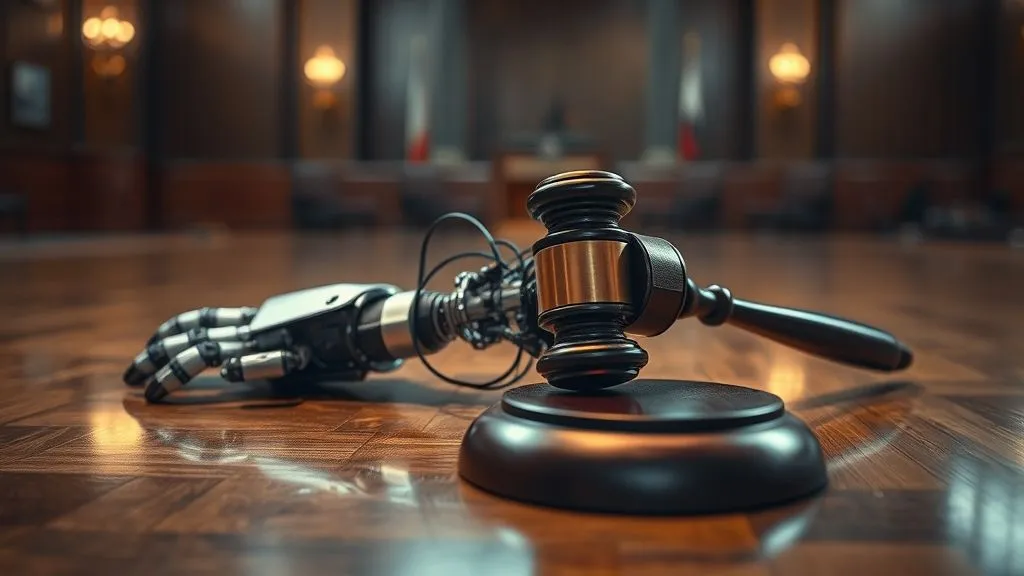
Establishing liability for AI-driven product malfunctions?
For over two decades in personal injury law, I've witnessed countless battles over product defects, from faulty vehicle components to dangerous medical devices. These cases, while complex, often relied on established legal precedents and tangible evidence. However, nothing quite prepares you for the new frontier: the intricate, often opaque world of artificial intelligence and its potential to cause harm.
The rise of AI-driven products – from autonomous vehicles to diagnostic software and smart home devices – introduces unprecedented challenges when things go wrong. When an AI system malfunctions, causing injury or damage, the traditional lines of product liability blur. The 'black box' nature of many advanced AI algorithms, combined with their continuous learning capabilities, makes identifying a clear defect and assigning blame incredibly difficult for both victims and legal professionals.
In this definitive guide, I will share my insights and provide a comprehensive framework for **establishing liability for AI-driven product malfunctions?**. We'll delve into actionable strategies, explore potential defendants, examine crucial legal theories, and discuss the forensic approaches needed to navigate these complex claims effectively. My goal is to equip you with the knowledge and tools necessary to seek justice in this rapidly evolving legal landscape.
The Unprecedented Challenge of AI in Product Liability
Traditional product liability law, built on principles developed over decades, generally focuses on three types of defects: manufacturing defects, design defects, and warning defects. When a tangible product fails, it's usually possible to trace the flaw back to a specific point in its creation or design. With AI, this linear path often breaks down, presenting a paradigm shift in how we approach accountability.
The dynamic and autonomous nature of AI systems introduces variables that were simply non-existent in previous generations of products. An AI isn't a static entity; it learns, adapts, and evolves, sometimes in unpredictable ways. This continuous evolution means that a product that was safe at the point of sale might become dangerous due to subsequent data inputs, software updates, or even its own unsupervised learning processes.
Traditional Product Liability vs. AI: A Paradigm Shift
Consider a traditional car with a faulty brake pedal. The defect is physical and usually traceable to the manufacturing line or a design flaw. Now, imagine an autonomous vehicle whose AI-driven braking system fails. Was it a flaw in the initial algorithm design? Was the training data biased or insufficient? Did a sensor malfunction, or was the AI's real-time decision-making process flawed due to an unforeseen environmental condition?
These questions highlight the profound shift. The 'product' itself is no longer just hardware; it's an intricate interplay of hardware, software, data, and complex algorithms. This necessitates a multi-faceted approach to liability, examining each component and its contribution to the malfunction.
The dynamic and adaptive nature of AI systems fundamentally complicates the identification of a clear, static defect, challenging the very foundations of traditional product liability law.
Deconstructing AI: Identifying Potential Points of Failure
To effectively establish liability, we must first understand where AI systems can fail. It's not a monolithic entity; rather, it's a complex ecosystem of interconnected components. As an experienced litigator, I've learned that dissecting these systems into their constituent parts is the first critical step in identifying potential defects and, subsequently, responsible parties.
The potential points of failure in an AI-driven product can generally be categorized into software development, data training, and hardware integration. Each of these areas presents unique challenges for forensic investigation and legal argumentation.
Software Development and Algorithmic Bias
The core of any AI system is its software and algorithms. Malfunctions can stem from errors in coding, flawed algorithmic design, or even unintended biases embedded within the algorithm itself. For instance, an algorithm designed to detect objects might be less accurate with certain demographics if its training data was disproportionately skewed.
Proving a defect here often requires expert testimony from AI ethicists, data scientists, and software engineers who can analyze the source code, algorithmic logic, and decision-making processes. This is where the 'black box' problem is most acute, as proprietary algorithms are often closely guarded trade secrets.
Data Training and Integrity Issues
AI systems learn from data. If the data used to train an AI is incomplete, inaccurate, biased, or manipulated, the AI's performance will inevitably suffer, potentially leading to malfunctions. For example, an autonomous vehicle trained primarily on sunny, clear roads might malfunction in heavy fog if it wasn't adequately exposed to such conditions during its training phase.
Investigating data integrity involves scrutinizing the data collection process, the quality of the datasets, and the methods used for data annotation and validation. A defect here isn't in the code itself, but in the 'knowledge' the AI acquired, which can be just as dangerous.
Hardware Integration and Sensor Malfunctions
Even the most sophisticated AI needs hardware to operate in the real world. Sensors (cameras, lidar, radar), processors, and actuators are all physical components that can fail due to manufacturing defects, design flaws, or improper integration. If an autonomous system's sensor fails to detect an obstacle, the AI, no matter how perfectly programmed, cannot react appropriately.
While more akin to traditional product liability, the integration of hardware with AI adds complexity. Was the sensor faulty, or did the AI fail to correctly interpret the data it received from a properly functioning sensor? This requires a holistic investigation into both the physical and digital components.
Who's on the Hook? Navigating the Web of Potential Defendants
One of the most perplexing questions when an AI-driven product malfunctions is: who is responsible? Unlike a simple mechanical product where the manufacturer is typically the primary defendant, AI products often involve a complex ecosystem of entities, each playing a critical role in the product's development, deployment, and operation. As I always tell my junior associates, 'Follow the data, follow the code, and follow the money.'
Identifying all potential defendants is crucial for a comprehensive liability claim. This can include traditional manufacturers, software developers, data providers, system integrators, and even the end-user in certain circumstances. The specific role each party played in the product's lifecycle and the nature of the alleged defect will dictate who can be held liable.
| Role | Potential Liability | Challenge |
|---|---|---|
| Manufacturer (Hardware) | Manufacturing defects, design defects, warning defects (physical components) | Proving physical defect vs. AI software/data issue |
| AI Developer/Programmer | Algorithmic design flaws, coding errors, insufficient testing, inherent bias | Proprietary 'black box' algorithms, proving software causation |
| Data Provider/Curator | Providing biased, incomplete, or erroneous training data | Tracing specific data inputs to malfunction, data provenance |
| System Integrator | Improper integration of AI components with hardware, system-level design flaws | Distinguishing integration errors from component-specific defects |
| End-User/Operator | Misuse of product, failure to follow instructions (limited cases) | High bar for user error when AI is designed for autonomy |
The Manufacturer: Design, Manufacturing, and Warning Defects
The entity that brings the physical product to market still bears significant responsibility. If the hardware component of an AI-driven device has a manufacturing flaw, or if the overall design of the integrated system is inherently unsafe (e.g., poor sensor placement), the manufacturer can be held liable. Furthermore, if inadequate warnings are provided about the AI's limitations or required operating conditions, this could also be a basis for a claim.
However, the challenge here is distinguishing hardware-related defects from software or data-related malfunctions. It requires meticulous investigation and often involves reverse engineering and forensic analysis of the physical components.
The AI Developer/Programmer: Software Malfunctions
The company or individual responsible for designing, coding, and implementing the AI's algorithms is a prime candidate for liability when the malfunction stems from the software itself. This includes errors in the code, flaws in the algorithmic logic, or even the failure to adequately test the AI under various conditions before deployment.
The legal argument often centers on whether the software was negligently designed or programmed, or if it constitutes a 'design defect' in the context of strict liability. Accessing proprietary code and internal development documents is critical here, often requiring aggressive discovery tactics.
Data Providers and Integrators: Data Contamination and Integration Errors
Those who supply the vast datasets used to train AI models, or those who integrate various AI components into a cohesive product, can also be held accountable. If a data provider supplies biased or corrupted data that leads to an AI malfunction, they could be liable for contributing to the defect. Similarly, an integrator who fails to properly combine different AI modules or integrate them safely with hardware could be responsible for system-level failures.
This category of defendant highlights the distributed nature of responsibility in the AI ecosystem. Proving causation requires tracing the malfunction back to the specific data input or integration point, a task that demands highly specialized technical expertise.
Proving Causation in an AI-Driven Incident: A Forensic Approach
In any personal injury claim, proving causation is paramount. You must demonstrate a direct link between the defect and the injury sustained. In the realm of AI, this becomes exponentially more challenging due to the 'black box' problem and the complex, adaptive nature of these systems. As I've often said in court, 'You can't prove what you can't see, or what's constantly changing.'
Establishing causation for an AI-driven malfunction requires a sophisticated, multi-disciplinary forensic approach. It's not enough to simply state that the AI failed; you must pinpoint *why* it failed and how that failure directly led to the harm.
Establishing a Defect: The 'Black Box' Dilemma
Many advanced AI systems, particularly those based on deep learning, operate as 'black boxes.' Their decision-making processes are so complex and opaque that even their creators struggle to fully explain why a particular output was generated. This inherent opacity makes it incredibly difficult to identify a specific, static defect in the traditional sense.
Instead of looking for a single faulty component, we often must analyze the AI's behavior, its inputs, and its outputs to infer a defect. This often involves reverse engineering, simulation, and extensive data analysis to identify patterns of failure under specific conditions.
The Role of Expert Witnesses and Digital Forensics
Expert witnesses are not just helpful; they are absolutely indispensable in AI product liability cases. You'll need a team of highly specialized experts, including:
- AI/Machine Learning Engineers: To analyze algorithms, code, and training methodologies.
- Data Scientists: To scrutinize data integrity, bias, and provenance.
- Robotics/Systems Engineers: To evaluate hardware integration and overall system design.
- Human Factors Experts: To assess user interface, warnings, and potential for human-AI interaction errors.
- Forensic Digital Investigators: To retrieve and analyze logs, sensor data, and system recordings from the incident.
Digital forensics plays a crucial role in gathering the digital 'smoking gun.' This includes accessing event logs, sensor data, AI decision records, and any other data recorded by the AI system before, during, and after the incident. Preserving this data immediately after a malfunction is paramount, as it can be overwritten or corrupted.
The intricate nature of AI malfunctions demands an interdisciplinary team of expert witnesses capable of dissecting algorithms, analyzing vast datasets, and interpreting complex system behaviors to establish a compelling chain of causation.
Legal Theories of Liability for AI Malfunctions
Despite the novel challenges posed by AI, the existing legal frameworks of product liability, negligence, and warranty still form the foundation for **establishing liability for AI-driven product malfunctions?**. The key is to adapt these theories to the unique characteristics of AI.
Strict Product Liability: Design, Manufacturing, and Warning Defects
Strict product liability holds manufacturers and sellers liable for defective products, regardless of fault. This is often the most desirable theory for plaintiffs because it removes the burden of proving negligence.
- Design Defect: An AI system could be deemed defectively designed if its inherent algorithmic structure or decision-making logic makes it unreasonably dangerous, even when properly manufactured and used. For example, if an autonomous driving algorithm consistently makes unsafe decisions in a specific, foreseeable scenario.
- Manufacturing Defect: While less common for pure software, a manufacturing defect could apply if a specific instance of an AI product deviated from its intended design (e.g., a corrupted software installation unique to one device, or a faulty sensor in an integrated system).
- Warning Defect: If the AI product fails to provide adequate warnings about its limitations, potential risks, or the conditions under which it might malfunction, a warning defect claim could arise. This is especially relevant for AI systems that operate with partial autonomy or require human oversight.
Negligence: Duty, Breach, Causation, Damages
Negligence claims require proving that the defendant (e.g., manufacturer, developer, data provider) breached a duty of care, and that this breach directly caused the plaintiff's injuries. This theory is particularly useful when strict liability isn't applicable, or when the defect lies in the process of AI development or data provision.
- Duty of Care: Manufacturers and developers have a duty to design, develop, test, and deploy AI products that are reasonably safe.
- Breach of Duty: This could involve negligent algorithm design, insufficient testing, using biased or inadequate training data, failing to update vulnerable systems, or neglecting to implement reasonable safety protocols.
- Causation and Damages: As discussed, proving the link between the negligent act (or omission) and the resulting harm is the most challenging aspect.
Breach of Warranty: Express and Implied
Warranty claims assert that the product failed to live up to certain promises or expectations. These can be express (explicit statements or guarantees made by the seller) or implied (e.g., implied warranty of merchantability, which guarantees the product is fit for its ordinary purpose).
If an AI product is advertised with capabilities it doesn't possess, or if it fails to perform its basic functions safely, a breach of warranty claim could be viable. This might apply if an AI-powered diagnostic tool consistently provides incorrect diagnoses, contrary to its advertised accuracy.
Emerging Regulatory Frameworks and Legislative Landscape
Governments and regulatory bodies worldwide are grappling with the legal implications of AI. While specific legislation is still evolving, several initiatives are attempting to establish clearer guidelines for AI development, deployment, and liability. Staying abreast of these changes is crucial for any legal professional dealing with AI product liability.
The absence of a uniform global framework creates a patchwork of regulations, making cross-border AI liability cases particularly complex. However, these emerging frameworks often provide valuable insights into expected standards of care and potential areas of regulatory non-compliance that can bolster a liability claim.

One of the most significant developments is The EU AI Act, which aims to classify AI systems by risk level and impose stringent requirements on high-risk AI. This includes obligations for data quality, human oversight, transparency, and robustness. While not directly a liability law, non-compliance with these regulations could serve as strong evidence of negligence in a product liability case.
In the United States, various federal agencies and state legislatures are exploring different approaches, from guidance documents to potential new legislation. Understanding these evolving standards will be key to arguing what constitutes a 'reasonable' level of safety and due diligence in AI development.
Building Your Case: Actionable Steps for Personal Injury Attorneys
As an attorney, when a client comes to you with an injury caused by an AI-driven product, your approach needs to be methodical and technologically informed. Here are the actionable steps I recommend to build a robust case for **establishing liability for AI-driven product malfunctions?**:
- Immediate Data Preservation: Advise your client to preserve the product and any associated devices (smartphones, cloud accounts) exactly as they were at the time of the incident. Critically, secure any data logs, sensor readings, and system recordings from the AI product. This is often the most volatile and crucial evidence.
- Engage Interdisciplinary Experts Early: Do not wait. Retain AI/ML engineers, data scientists, and digital forensic specialists as soon as possible. Their early involvement is essential for understanding the AI, identifying potential defects, and interpreting complex technical evidence.
- Identify All Potential Defendants: Cast a wide net. Research the entire supply chain of the AI product – from the hardware manufacturer to the software developer, data providers, and system integrators. Each entity involved in the AI's creation and deployment is a potential target.
- Deep Dive into AI Functionality and Limitations: Thoroughly understand how the specific AI system is designed to work, its advertised capabilities, and its known limitations. This will help identify discrepancies between expected and actual performance.
- Scrutinize Training Data and Algorithmic Design: Through discovery, demand access to training data, algorithmic design documents, and testing protocols. Look for evidence of bias, insufficiency, or negligent design choices that could lead to malfunction.
- Assess Damages Comprehensively: Beyond physical injuries, consider potential reputational damage, psychological harm, or economic losses resulting from AI malfunctions, especially in professional contexts.
- Stay Current with AI Law and Regulation: The legal landscape is constantly shifting. Regularly review new legislation, regulatory guidance, and case law pertaining to AI to strengthen your arguments.
Case Study: The Autonomous Vehicle Incident
Case Study: The Autonomous Vehicle Incident
Let's consider a fictional but realistic scenario I've advised on. Mrs. Davies was seriously injured when an autonomous delivery vehicle, 'Robo-Haul 3000,' unexpectedly swerved into her lane, causing a collision. The initial reports indicated no human driver intervention, and the vehicle's sensors appeared functional.
My team immediately moved to preserve the vehicle's black box data, including sensor readings, AI decision logs, and navigation system records. We brought in an AI forensics expert who analyzed the Robo-Haul's trajectory and decision algorithms. It turned out the vehicle's AI had been trained predominantly in urban environments with clear lane markings. On the rural road where the incident occurred, the lane markings were faded, and the AI's perception system, designed by 'VisionAI Corp,' misinterpreted a shadow as a lane boundary.
We argued a design defect against VisionAI Corp, claiming their AI's perception algorithm was not robust enough for diverse real-world conditions, and a warning defect against the vehicle manufacturer, 'Auto-Delivery Solutions,' for failing to adequately warn users of the AI's limitations on poorly marked roads. The data showed the AI made a 'decision' based on faulty perception, not a hardware failure.
This case study underscores the critical importance of digital forensic data and expert analysis to uncover the root cause of an AI malfunction, which often lies hidden within the algorithmic decision-making process. Without that data, establishing liability for AI-driven product malfunctions would have been nearly impossible.
The Future of Product Liability: Anticipating AI's Evolution
The legal challenges posed by AI are not static; they will continue to evolve as AI technology advances. We are moving towards increasingly autonomous and sophisticated systems, including those capable of 'self-modification' and continuous learning without human intervention. This will further blur the lines of responsibility and necessitate even more innovative legal strategies.
My experience tells me that proactive engagement with AI ethics, robust testing protocols, and clear accountability frameworks will be paramount. Regulators, developers, and legal professionals must collaborate to create a predictable and fair system for addressing AI-related harm. As Harvard Business Review highlights, the AI liability challenge is a complex, multifaceted issue requiring novel solutions.
Furthermore, the concept of 'foreseeability' in negligence claims will become increasingly nuanced. Can a developer foresee every possible emergent behavior of a highly complex, self-learning AI? This question will likely be at the forefront of future legal battles. Forbes also emphasizes the need for careful navigation of this evolving legal landscape.
Frequently Asked Questions (FAQ)
How does the 'black box' nature of AI impact proving a defect? The 'black box' problem makes it difficult to directly observe the AI's decision-making process. Instead of pinpointing a single faulty line of code, legal teams must rely on indirect evidence like input data, output behavior, and expert analysis of the algorithm's design and training to infer a defect. This often involves comparing expected behavior with actual performance under specific conditions.
Can an AI developer be held strictly liable for a software-only malfunction? In many jurisdictions, strict product liability traditionally applies to tangible 'products.' While some courts have expanded this to include software as a 'product,' it's not universally accepted. Often, negligence claims are more straightforward against developers for flawed code or inadequate testing. However, if the software is integral to a physical product, it's easier to argue strict liability against the overall product manufacturer.
What role do End-User License Agreements (EULAs) play in AI product liability? EULAs often contain disclaimers and limitations of liability. While these can be powerful, they are not absolute. Courts scrutinize EULAs, especially in personal injury cases, and may deem certain clauses unconscionable or against public policy, particularly if they attempt to waive liability for gross negligence or severe defects. They are a factor but rarely a complete shield for developers or manufacturers.
How do AI updates and continuous learning affect liability? This is a major challenge. If an AI product is safe at the point of sale but becomes dangerous due to a subsequent update or through its own continuous learning, determining the point of defect becomes complex. It raises questions about the manufacturer's ongoing duty to monitor, update, and ensure safety throughout the product's lifecycle, potentially creating new forms of post-sale liability.
What initial steps should a victim take after an AI product malfunction? The absolute first step is to ensure safety and seek medical attention if necessary. Then, it's crucial to preserve all evidence: the malfunctioning AI product itself, any associated devices (phones, tablets), digital logs, photos or videos of the incident, and contact information for witnesses. Do not attempt to fix or alter the product. Contacting an attorney specializing in product liability and AI is critical for guiding these initial preservation efforts.
Key Takeaways and Final Thoughts
The advent of AI-driven products marks a new era in product liability law, presenting unique and formidable challenges for victims seeking justice. As an industry specialist, I believe that understanding these complexities is the first step towards effective legal action.
- **AI liability is multi-faceted:** It involves hardware, software, data, and complex algorithms, each a potential point of failure.
- **Interdisciplinary expertise is crucial:** You cannot navigate these cases without a team of highly specialized AI, data, and forensic experts.
- **Traditional legal theories still apply:** Strict liability, negligence, and warranty claims remain the foundation, but require adaptation to AI's unique characteristics.
- **Data preservation is paramount:** Digital evidence is often the 'smoking gun,' but it's volatile and must be secured immediately.
- **The legal landscape is evolving:** Stay informed on new regulations and legislative efforts, such as initiatives by the Department of Justice, that will shape future AI liability cases.
While the path to **establishing liability for AI-driven product malfunctions?** is challenging, it is not insurmountable. With a strategic, technologically informed, and persistent approach, justice can be found even in the most opaque corners of artificial intelligence. Your role in advocating for those harmed by these advanced systems is more critical now than ever before.
Recommended Reading
- 5 Critical Steps When an Employee Refuses Reasonable ADA Accommodation
- Commercial Escrow Disputes: 7 Steps to Resolution in Complex Deals
- Urgent: 5 Steps to Quickly Remove a Mechanic's Lien Before Closing
- Ultimate Guide: Athlete Agent Contract Negotiation Tips
- NFT IP Theft: 7 Legal Steps to Reclaim Your Digital Art Rights




Comments
Leave a comment below. Your email will not be published. Required fields marked with *