


How to challenge a K-9 sniff search that extended beyond a lawful traffic stop?
For over two decades practicing constitutional law, I've witnessed countless individuals grapple with the frightening and often confusing reality of police K-9 sniff searches during routine traffic stops. What starts as a simple pullover for a minor infraction can quickly escalate, leaving drivers feeling powerless and their Fourth Amendment rights seemingly eroded.
The core problem lies in the blurred lines surrounding the permissible duration of a traffic stop and the introduction of a drug detection dog. Many believe that if a K-9 alerts, the search is automatically lawful, regardless of how long they were detained. This widespread misconception leaves citizens vulnerable to unconstitutional searches, and I've seen the devastating impact it can have on their lives.
In this definitive guide, I will arm you with the expert knowledge and actionable strategies necessary to understand, identify, and effectively challenge a K-9 sniff search that extended beyond a lawful traffic stop. We'll delve into critical legal precedents, explore the nuances of reasonable suspicion, and provide a framework for gathering evidence and navigating the complex legal landscape to protect your fundamental rights.
Understanding the Legal Landscape: Fourth Amendment & K-9 Searches
To effectively challenge an extended K-9 sniff, you must first grasp the foundational legal principles at play. The Fourth Amendment to the U.S. Constitution is your shield, protecting you from unreasonable searches and seizures. It dictates that law enforcement generally needs a warrant or probable cause to conduct a search.
The Fourth Amendment Baseline
A traffic stop, even for a minor infraction, is considered a "seizure" under the Fourth Amendment. However, it's generally considered reasonable if the officer has probable cause to believe a traffic violation occurred. The critical limitation, established in cases like Rodriguez v. United States, is that the stop's duration must be limited to the time reasonably required to complete the mission of the stop – addressing the traffic violation. Any extension beyond this mission requires independent reasonable suspicion.
The Nuance of K-9 Sniffs
A K-9 sniff around the exterior of a vehicle is unique. The Supreme Court, in Illinois v. Caballes, held that a dog sniff itself is not a "search" within the meaning of the Fourth Amendment, provided it doesn't prolong the stop. This is because it only reveals the presence or absence of contraband, in which there is no legitimate privacy interest. The moment that sniff does prolong the stop without reasonable suspicion, however, it transforms into an unconstitutional detention, and any subsequent search or evidence found may be suppressed.
"The critical distinction lies not in the sniff itself, but in the time it takes. If the K-9's deployment extends the stop beyond what's necessary to address the initial traffic violation, absent independent reasonable suspicion, it's a constitutional violation." - My professional insight.
This subtle but profound difference is where many challenges gain traction. It's not about the dog's nose, but the officer's clock and their justification for running it longer.

When Does a Traffic Stop Become Unlawful Detention?
The heart of challenging an extended K-9 sniff lies in proving that the initial lawful traffic stop transformed into an unlawful detention. This occurs when an officer extends the stop beyond the time necessary to complete its original mission without independent, articulable reasonable suspicion of criminal activity.
Reasonable Suspicion vs. Mere Hunch
Reasonable suspicion is a lower standard than probable cause, but it's not a mere hunch. It requires specific, articulable facts that, taken together with rational inferences from those facts, reasonably warrant the intrusion. These facts must point to criminal activity. For instance, an officer cannot extend a stop solely because a driver looks nervous or is traveling on a known drug corridor. There must be more.
Timeliness: The Key Factor
The Supreme Court in Rodriguez v. United States made it clear: the tolerable duration of a traffic stop is determined by the time it takes to complete the "mission" of the stop. This includes checking the driver's license, vehicle registration, and proof of insurance, and issuing a ticket or warning. Any additional investigation, such as a K-9 sniff, must not add time to the stop unless there's independent reasonable suspicion. This means the K-9 must arrive and perform its sniff within the time it would have taken the officer to complete the traffic stop's original purpose.
| Activity | Typical Duration | Legal Impact |
|---|---|---|
| License/Registration Check | 2-5 minutes | Permissible mission-related activity |
| Warrant Check | 3-7 minutes | Permissible mission-related activity |
| Issuing Citation/Warning | 2-5 minutes | Permissible mission-related activity |
| K-9 Deployment (No RS for delay) | Adds >0 minutes | Unconstitutional if it extends stop beyond mission |
I've seen officers try to justify delays by claiming they were still "processing paperwork." While some minor delays are inherent, a delay specifically to wait for a K-9 unit, without reasonable suspicion of other criminal activity, is a red flag for an unconstitutional extension.
Identifying an Extended Stop for K-9 Deployment
Recognizing when a stop has been unlawfully extended is crucial. It often involves a combination of timing, officer actions, and the lack of new, legitimate suspicions arising during the initial mission of the stop.
The 'Mission-Related' Inquiry
The core inquiry is whether the officer's actions, including calling for a K-9, are part of the original traffic stop's mission or directly related to it. If the officer has completed all tasks related to the traffic violation – such as returning documents, issuing a warning, or writing a ticket – and then detains you further to wait for a K-9, that additional detention must be supported by new, independent reasonable suspicion.
For example, if an officer pulls you over for speeding, runs your license, checks your registration, and then informs you they are waiting for a K-9 unit to arrive, and you've already been detained for 10-15 minutes without any new suspicious activity, that's a strong indicator of an unlawful extension.
Factors Indicating Extension
- Completion of Traffic Stop Tasks: All documents returned, warning/citation issued, and no further questions about the initial violation.
- Explicit Statement of Waiting: Officer explicitly states they are waiting for a K-9, or makes a call for one after the initial stop's purpose is fulfilled.
- Time Elapsed: The duration of the stop significantly exceeds the typical time for a routine traffic stop (often more than 15-20 minutes for a standard stop without complications).
- Change in Officer Demeanor/Questions: Officer shifts from questions about the traffic violation to general criminal interdiction questions (e.g., "Where are you coming from/going?", "Do you have large sums of cash?").
Building Your Challenge: Key Legal Arguments
Once you suspect an unlawful extension, the next step is to formulate precise legal arguments. In my experience, these are the most effective avenues for challenging K-9 sniff searches that extended beyond a lawful traffic stop.
Argument 1: Lack of Reasonable Suspicion for Extension
This is often the strongest argument. You must contend that even if the officer had initial reasonable suspicion for the traffic stop, they lacked independent reasonable suspicion to prolong the stop specifically to conduct a K-9 sniff. The officer must articulate specific facts that would lead a reasonable officer to believe that criminal activity was afoot, beyond the initial traffic violation. Nervousness, travel itinerary, or type of vehicle are generally insufficient on their own.
Argument 2: Unreasonable Delay in K-9 Arrival
Even if the officer develops reasonable suspicion during the lawful duration of the stop, the K-9 must arrive within a reasonable time. There's no bright-line rule for "reasonable," but courts scrutinize delays. If the K-9 unit was not immediately available and the officer detained you for an extended period solely to wait for its arrival, this delay can render the subsequent sniff unconstitutional. This argument hinges on the Rodriguez precedent.
Argument 3: Reliability of the K-9 and Handler
While less common for the "extended stop" argument, if a K-9 alert leads to a search, the defense can challenge the reliability of the dog and handler. This involves examining the dog's training records, certification, and past performance (e.g., false positive rates). If the K-9's reliability is questionable, its alert may not establish probable cause. This is especially relevant if the officer relied heavily on the K-9's perceived reliability to justify a search after an ambiguous alert.
- Review Police Reports: Scrutinize every detail for mentions of time, officer actions, and stated justifications for the K-9 call.
- Demand Dashcam/Bodycam Footage: This is your most powerful tool. It provides an objective timeline and visual evidence of the stop's duration and officer conduct.
- Obtain K-9 Certification & Training Records: These documents are crucial for challenging the dog's reliability.
- Interview Witnesses: If anyone else was present, their testimony can corroborate your account of the timeline and events.
- Document Your Own Account: Immediately after the incident, write down everything you remember, including times, conversations, and feelings.
Gathering this information meticulously is paramount. Without it, your legal challenge becomes significantly harder to prove. I've seen cases turn entirely on the precise timestamp of a K-9's arrival relative to the completion of the traffic stop's mission.

The Importance of Evidence: What to Collect and How
In constitutional law cases, the burden often shifts to the defense to prove a violation occurred. That's why meticulous evidence collection is not just helpful; it's absolutely critical. Without solid evidence, even the most compelling legal arguments can falter.
Dashcam and Bodycam Footage
This is arguably your strongest piece of evidence. Most police vehicles are equipped with dashcams, and many officers wear bodycams. These recordings capture the entire interaction, providing an objective timeline of the stop, the officer's statements, and the K-9's deployment. You can determine precisely when the initial traffic stop's mission was completed and when the K-9 arrived. Your attorney will typically subpoena this footage.
Witness Statements and Personal Notes
If you had passengers, their testimony can be invaluable. Encourage them to write down their recollections as soon as possible. Similarly, you should immediately write down everything you remember: the time of the stop, the reason given, the officer's name/badge number, what was said, the sequence of events, and the duration of the stop. Be as detailed as possible. These contemporaneous notes carry more weight than recollections made weeks or months later.
Case Study: The Over-Extended Stop and the Suppressed Evidence
Case Study: Maria's Unconstitutional K-9 Search
Maria was pulled over for a minor lane violation in a rural county. The officer quickly checked her license and registration, confirming everything was in order. He then returned her documents, but instead of issuing a warning or ticket, he began asking general questions about her travel plans and whether she had any large amounts of cash or drugs. Maria, feeling intimidated, answered vaguely. After about 12 minutes, with no new suspicious facts emerging, the officer stated, "My K-9 unit is on the way, just a few more minutes." The K-9 arrived 8 minutes later, 20 minutes into the stop, and alerted. A subsequent search found a small amount of marijuana. Maria's attorney immediately filed a motion to suppress. Through dashcam footage, they demonstrated that the initial mission of the stop was complete at the 10-minute mark, and no new reasonable suspicion had developed to justify the additional 10-minute detention awaiting the K-9. The court agreed, ruling the detention unconstitutional under Rodriguez, and the evidence was suppressed. This case highlights how critical the timeline and lack of independent reasonable suspicion are.
Navigating the Courts: Motions to Suppress
The primary legal mechanism for challenging an unconstitutional K-9 sniff search is a "Motion to Suppress Evidence." This is a pre-trial motion filed by your attorney, asking the court to exclude any evidence obtained as a result of the unlawful search or seizure.
Understanding the Motion to Suppress
A Motion to Suppress argues that the evidence against you was obtained in violation of your constitutional rights (in this case, your Fourth Amendment rights). If the motion is granted, the illegally obtained evidence cannot be used against you in court. In many drug possession cases, if the evidence from the K-9 search is suppressed, the prosecution may have no choice but to drop the charges entirely, as their primary evidence has been deemed inadmissible.
The Burden of Proof
Initially, the burden is on the prosecution to prove that the search and seizure were lawful. However, once you raise a Fourth Amendment challenge, the burden shifts to the defense to articulate specific facts and legal arguments as to why the search was unconstitutional. This is where your meticulously collected evidence and your attorney's expertise become paramount. Your attorney will present arguments, often supported by witness testimony (including the officer's) and video evidence, to demonstrate that the stop was unlawfully extended without reasonable suspicion.

Seeking Expert Legal Counsel: Your Best Defense
While understanding these principles empowers you, attempting to navigate the complexities of constitutional law and court procedures alone is a perilous undertaking. This is where an experienced constitutional law attorney becomes your most valuable asset.
Why a Constitutional Law Attorney is Crucial
An attorney specializing in constitutional law and criminal defense understands the intricate nuances of Fourth Amendment jurisprudence, including the ever-evolving case law surrounding K-9 searches. They know what questions to ask, what evidence to seek, and how to present a compelling argument in court. I've seen countless individuals try to represent themselves, only to miss critical legal deadlines or fail to properly articulate their rights, leading to unfavorable outcomes.
A skilled attorney will:
- Review all available evidence, including dashcam/bodycam footage and police reports.
- Identify specific points of legal vulnerability in the prosecution's case.
- File timely and well-reasoned Motions to Suppress.
- Cross-examine officers effectively to highlight inconsistencies or lack of reasonable suspicion.
- Negotiate with prosecutors from a position of strength, often leading to reduced charges or dismissals.
Questions to Ask Your Attorney
When consulting with an attorney, be prepared to discuss the details of your stop and ask pertinent questions to gauge their expertise:
| Question | Importance |
|---|---|
| What specific experience do you have with K-9 sniff search challenges? | Crucial for specialized knowledge |
| What is your strategy for obtaining and reviewing evidence (e.g., dashcam footage, K-9 records)? | Reveals proactive approach |
| Based on the details I've provided, what are the likely legal arguments we can make? | Assesses their immediate understanding |
| What are the potential outcomes if a Motion to Suppress is filed? | Manages expectations |
| What are your fees and payment structure? | Transparent financial planning |
Don't hesitate to seek out an attorney who instills confidence and demonstrates a deep understanding of this specific area of law. Your freedom and future may depend on it. For further reading on the evolving standards of K-9 searches, I recommend reviewing academic analyses on the subject from reputable legal journals.
Common Misconceptions and Your Rights
Navigating an interaction with law enforcement can be intimidating, and many people operate under common misconceptions about K-9 searches that can inadvertently waive their rights. Let's clarify a few.
"If the dog alerts, it's always valid."
False. While a K-9 alert generally provides probable cause for a search, the alert itself must occur during a lawful detention. If the detention was unlawfully extended for the K-9, then the alert, and any subsequent search, is the fruit of an illegal stop and can be challenged. Furthermore, the K-9 and handler's training and certification can be challenged to question the reliability of the alert itself. Dogs are not infallible; they make mistakes, and handlers can sometimes cue them, consciously or unconsciously. The American Bar Association has published extensively on this topic.
"You can't refuse a K-9 sniff."
Partially true, but misleading. You cannot physically prevent an officer from walking a K-9 around your vehicle if they have the legal right to do so (i.e., during the lawful duration of a stop, or with independent reasonable suspicion for an extension). However, you absolutely have the right to refuse consent to a search of your vehicle. Officers often ask, "Do you mind if I search your car?" or "Can the dog sniff around your car?" Politely but firmly state, "I do not consent to any searches." This refusal cannot be used against you as evidence of guilt. Remember, the K-9 sniff itself is not a search in the eyes of the law, but the physical search of your car after an alert is, and you can refuse consent to that search if you believe the alert was invalid or the stop was unlawful.
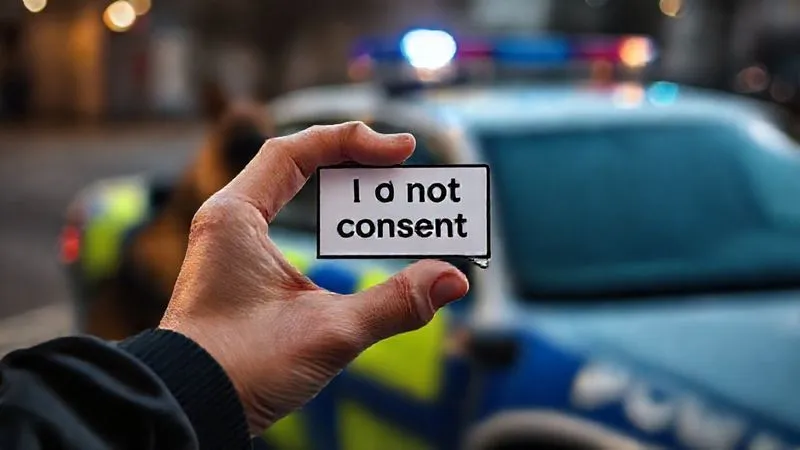
Always remember that while you must comply with lawful police orders, you are not required to give up your constitutional rights. Understanding the distinction is paramount.
For more detailed information on your rights during a police encounter, resources like the ACLU's 'Know Your Rights' guides are invaluable.
Frequently Asked Questions (FAQ)
What is the difference between reasonable suspicion and probable cause in the context of K-9 searches? Reasonable suspicion is a lower standard, requiring specific, articulable facts that suggest criminal activity is afoot, justifying a brief detention or investigation like waiting for a K-9 within the lawful duration of a stop. Probable cause, a higher standard, means there's a fair probability that contraband or evidence of a crime will be found, typically established by a K-9 alert (if the alert itself is lawful) or other strong evidence, justifying a full search of the vehicle.
Can an officer extend my traffic stop just because they called for a K-9 unit? No, not without independent reasonable suspicion that criminal activity is afoot. The Supreme Court in Rodriguez v. United States explicitly stated that a traffic stop cannot be prolonged beyond the time necessary to complete the mission of the stop (e.g., writing a ticket) simply to await a K-9's arrival. If there's no new, articulable reasonable suspicion, any delay for a K-9 makes the detention unconstitutional.
What if the K-9 alerts, but no drugs are found? Can I still challenge the initial stop? Absolutely. A "false positive" or "no find" after a K-9 alert doesn't automatically validate the initial detention. If the stop was unlawfully extended for the K-9 in the first place, the entire chain of events, including the alert and subsequent search, is tainted. Furthermore, repeated false alerts by a specific K-9 can be used to challenge that dog's overall reliability, even if drugs were found.
How quickly should I act if I believe my Fourth Amendment rights were violated during a K-9 sniff search? Immediately. Time is of the essence. Memories fade, and evidence can be lost or overwritten (especially video footage). Contact a qualified constitutional law attorney as soon as possible after the incident. They can advise you on preserving evidence, understanding deadlines, and initiating legal action, such as filing a Motion to Suppress.
Does my state's law offer more protection than the Fourth Amendment regarding K-9 searches? Potentially. While the Fourth Amendment sets the federal baseline, many states have their own constitutional provisions that can offer greater protections for citizens against unreasonable searches and seizures. An experienced attorney in your specific jurisdiction will be able to advise whether your state's constitution or case law provides additional grounds for challenging a K-9 sniff search.
Key Takeaways and Final Thoughts
- Know Your Rights: The Fourth Amendment protects you from unreasonable searches and seizures, but its application to K-9 sniffs is nuanced.
- Time is Critical: An officer cannot extend a traffic stop beyond its original mission to wait for a K-9 without independent reasonable suspicion.
- Document Everything: Dashcam/bodycam footage, personal notes, and witness statements are invaluable evidence.
- Challenge Unlawful Extensions: A Motion to Suppress is the primary legal tool to exclude evidence obtained from an unconstitutional K-9 search.
- Seek Expert Counsel: A constitutional law attorney is essential for navigating the complexities and effectively defending your rights.
In my years of practice, I've seen firsthand how intimidating and confusing encounters with law enforcement, especially those involving K-9 units, can be. But remember, you are not without recourse. By understanding your rights, recognizing the indicators of an unlawful stop, and proactively engaging with experienced legal counsel, you can effectively challenge a K-9 sniff search that extended beyond a lawful traffic stop. Empower yourself with knowledge and stand firm in protecting your constitutional liberties. Your diligence today can significantly impact your future.
Recommended Reading
- 7 Critical Steps: Business Continuity Without an Owner's Advance Directive
- 7 Legal Pillars: Shielding Your Sports Event from Waiver Challenges
- 7 Proven Steps: Uncover Hidden Income & Secure Child Support
- Marine Insurance: What Damage is Covered? The Ultimate Guide
- How to Challenge Ineffective Assistance of Counsel Claims Effectively





Comments
Leave a comment below. Your email will not be published. Required fields marked with *