


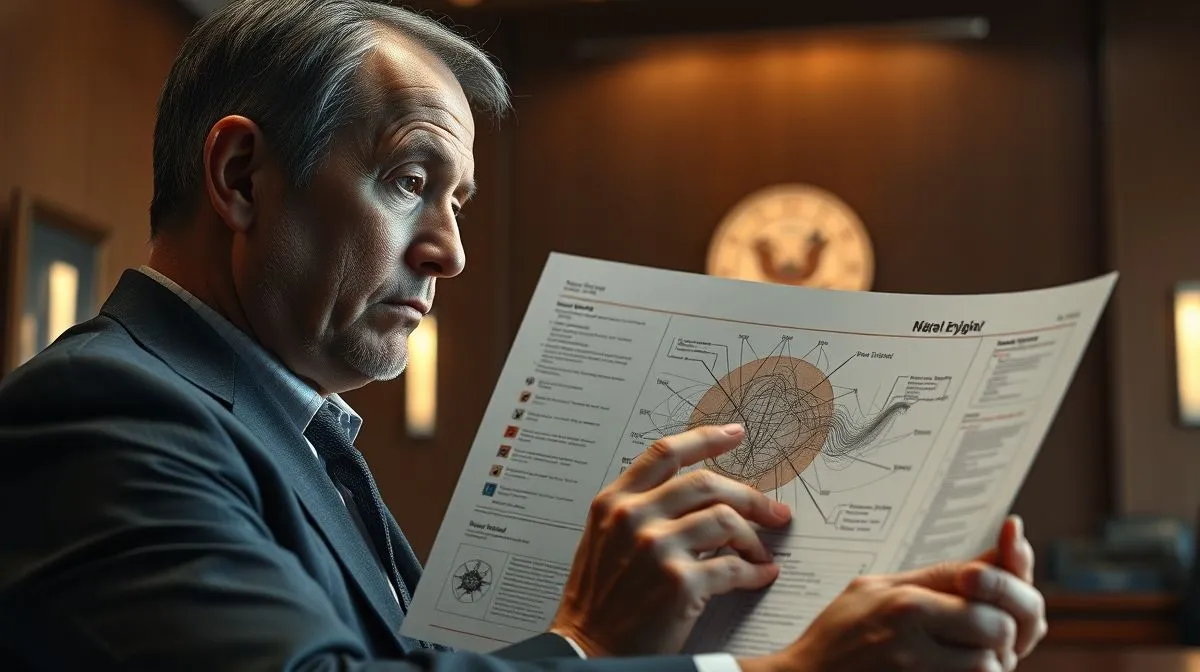
How to Overcome Juror Skepticism in Mild Traumatic Brain Injury Cases?
For over two decades in the personal injury sphere, I've witnessed firsthand the profound challenges victims of mild traumatic brain injury (mTBI) face in the courtroom. It's a unique battle, not just against the opposing counsel, but often against deeply ingrained societal perceptions and a fundamental misunderstanding of what mTBI truly entails.
The core problem lies in the invisible nature of these injuries. Unlike a broken bone or a visible laceration, mTBI often leaves no obvious external scar, and traditional imaging like MRIs or CT scans frequently come back 'normal.' This lack of overt physical evidence breeds skepticism, making it incredibly difficult for jurors, who are laypersons, to connect the dots between a seemingly minor incident and life-altering cognitive or emotional impairments.
In this definitive guide, I will share the strategies, insights, and frameworks I've honed over years of litigation to help you effectively overcome juror skepticism in mild traumatic brain injury cases. We will delve into actionable steps, robust evidence presentation, and persuasive communication techniques that have consistently turned doubt into understanding and, ultimately, favorable outcomes.
Understanding the Root of Skepticism: Why Jurors Doubt
Before we can overcome skepticism, we must first understand its origins. Jurors are intelligent individuals, but they rely on what they can see, hear, and easily comprehend. When it comes to mTBI, several factors conspire to create a fertile ground for doubt.
The "Invisible Injury" Paradox
Human beings are wired to trust their senses. If they can't see an injury, they struggle to believe its severity. A concussion, by definition, is a functional injury, not necessarily a structural one visible on standard scans. This leads to the paradox: the victim looks fine, perhaps even acts fine in brief interactions, yet their internal world is in turmoil. Jurors often think, "If there's nothing wrong on the MRI, how bad can it really be?"
Preconceived Notions and Media Influence
Society's understanding of brain injury is heavily influenced by media portrayals, often focusing on severe, obvious cases. There's also a pervasive, albeit incorrect, belief that a concussion is just a 'ding' to the head, something you 'shake off.' This minimizes the genuine, often debilitating, long-term effects of mTBI, making jurors resistant to the idea that a 'mild' injury can cause such significant suffering.
Lack of Objective Markers
Unlike blood tests for infection or X-rays for fractures, there isn't one definitive, universally accepted biomarker for mTBI. While neuropsychological testing and advanced imaging are crucial, their interpretation requires expertise that jurors lack. This perceived lack of a 'smoking gun' can lead jurors to dismiss subjective complaints as exaggeration or malingering.
The Art of Storytelling: Humanizing the Injury
At its core, a trial is a story. To overcome juror skepticism in mild traumatic brain injury cases, you must make the victim's story the compelling centerpiece. This means moving beyond medical jargon and focusing on the human impact of the injury.
Before & After Narratives
This is perhaps the most powerful tool in your arsenal. You must paint a vivid picture of who the plaintiff was before the injury and how their life has irrevocably changed after it. Show, don't just tell. Describe their hobbies, their professional life, their family roles, their personality, and then meticulously detail how each of these facets has been diminished or lost due to the mTBI. Focus on the loss of identity and function.
Collateral Witnesses: The Power of Observation
The plaintiff's own testimony, while essential, can be seen as self-serving. This is where collateral witnesses become invaluable. These are individuals who knew the plaintiff well before the injury and can credibly testify to the changes they observed. Think about:
- Spouses or Partners: They see the daily struggles, the emotional shifts, the memory lapses.
- Close Family Members (Parents, Siblings, Adult Children): They can speak to personality changes or loss of independence.
- Friends: They notice the withdrawal from social activities, the difficulty maintaining conversations.
- Co-workers or Supervisors: They can testify to diminished performance, difficulty with tasks, or changes in work ethic and focus.
- Coaches or Activity Leaders: If the plaintiff was active, they can describe the loss of ability in sports or hobbies.
Expert Insight: "Jurors often respond more powerfully to the observations of objective third parties than to the injured person's own complaints. These witnesses provide the external validation that converts subjective symptoms into credible, observable facts."
Leveraging Objective Evidence: Bridging the Credibility Gap
While mTBI is often invisible to the naked eye, modern science offers increasingly sophisticated ways to objectively demonstrate its effects. Presenting this evidence clearly and understandably is crucial for overcoming juror skepticism in mild traumatic brain injury cases.
Neuropsychological Testing: More Than Just IQ Scores
A comprehensive neuropsychological evaluation is the gold standard for documenting cognitive impairments following mTBI. Explain to the jury that these aren't just 'brain games,' but scientifically validated tests that measure specific cognitive domains (memory, attention, processing speed, executive function). Highlight discrepancies between pre-injury baseline (if available) and post-injury performance, or significant deviations from expected norms. Emphasize that these tests are designed to detect even subtle deficits and are difficult to 'fake.'
Advanced Imaging: Beyond the "Normal" MRI
Traditional MRIs often appear normal after mTBI because they primarily detect gross structural damage. However, newer technologies can reveal the subtle, microscopic changes characteristic of these injuries. Educate the jury on:
- Diffusion Tensor Imaging (DTI): Explaining how DTI measures the movement of water molecules along white matter tracts, revealing damage to the brain's 'wiring' even when the 'hardware' looks intact. Visuals showing disrupted tracts can be highly impactful.
- Functional MRI (fMRI): Demonstrating how fMRI measures brain activity by detecting changes in blood flow, showing areas of the brain that are underperforming or overcompensating.
- Positron Emission Tomography (PET) or Single-Photon Emission Computed Tomography (SPECT) Scans: These scans can reveal metabolic abnormalities in the brain, indicating areas of reduced function even without structural damage.
It's vital to explain that a 'normal' structural MRI doesn't mean a 'normal' brain. Just as a perfectly fine-looking electrical wire can have a broken circuit inside, the brain's functional connections can be disrupted. For more on the evolving science, consider referencing studies on advanced imaging techniques in brain injury, such as those found in journals like the New England Journal of Medicine or research from leading academic institutions.
Vestibular and Oculomotor Assessments
These tests measure balance and eye movement, often revealing objective deficits consistent with mTBI, especially in the areas of dizziness, vertigo, and visual tracking problems. These are physical manifestations of the brain injury that are difficult for jurors to dismiss as subjective.
Expert Insight: "While a 'normal' standard MRI can be a hurdle, a skilled attorney uses it as an opportunity to educate the jury on the limitations of such scans and introduces advanced imaging or neurocognitive testing to provide the objective proof they seek."
The Crucial Role of the Expert Witness: Education, Not Just Opinion
Your expert witness is not just there to offer an opinion; they are there to be the jury's teacher. Their ability to simplify complex medical and scientific concepts into understandable terms is paramount for overcoming juror skepticism in mild traumatic brain injury cases.
Selecting the Right Expert: Qualities Beyond Credentials
While credentials are non-negotiable, consider these equally vital qualities:
- Exceptional Communicator: Can they explain neuroscience to a layperson without condescension or overly technical jargon?
- Empathetic Demeanor: Do they connect with the jury and convey genuine concern for the plaintiff?
- Unflappable Under Cross-Examination: Can they maintain their composure and authority when challenged?
- Teaching Style: Do they use analogies, visual aids, and clear explanations to make complex concepts accessible?
A brilliant researcher who cannot communicate effectively is a liability. Look for someone who can truly educate the jury on the nuances of mTBI. Insights into selecting and preparing expert witnesses are often discussed in legal publications such as the Harvard Business Review (focusing on persuasive communication) or specialized legal journals.
Simplifying Complex Science for Laypersons
Your expert must break down concepts like axonal shearing, glial cell activation, or altered neural networks into relatable terms. Use analogies: compare the brain to a complex computer system where the 'software' is corrupted, or a finely tuned orchestra where the musicians are playing out of sync. Visual aids, like diagrams of neural pathways or simplified brain anatomy, are essential.
Expert Insight: "The most effective expert witness doesn't just present facts; they tell a story of the science behind the injury, making the invisible visible and the complex comprehensible to every juror."
Mastering Voir Dire: Shaping a Receptive Jury Pool
Jury selection is your first, and arguably most important, opportunity to address and mitigate potential juror skepticism about mTBI cases. This isn't just about weeding out biased jurors; it's about educating the entire panel.
Identifying and Challenging Biases
During voir dire, directly address the common misconceptions about brain injury. Ask questions like:
- "How many of you believe that if someone has a brain injury, it would always show up on an MRI or CT scan?"
- "Do any of you believe that a 'mild' injury can't cause serious, long-lasting problems?"
- "Have you or anyone you know ever 'shaken off' a concussion or been told to 'tough it out'?"
These questions not only reveal biases but also subtly introduce the idea that there's more to mTBI than meets the eye. They begin the education process even before opening statements. Challenge for cause those who express strong, unshakeable beliefs that contradict the medical realities of mTBI.
Expert Insight: "Voir dire is your opportunity to plant the seeds of understanding. Address skepticism head-on, but do so with empathy and an educational approach, not confrontation."
The Power of Analogy and Visual Aids: Making the Invisible Visible
Since mTBI is often invisible, you must create a visual and conceptual understanding for the jury. Analogies and visual aids are indispensable for overcoming juror skepticism in mild traumatic brain injury cases.
Everyday Analogies: The "Computer Glitch" or "Circuit Breaker"
Use simple, relatable analogies to explain complex brain functions and dysfunctions. For instance:
- The Computer Analogy: The brain is like a powerful computer. A severe TBI might be like smashing the hard drive (visible damage). A mild TBI is like a power surge or a virus that corrupts the software, making programs run slowly, crash, or freeze (invisible functional damage). The hardware looks fine, but the system is broken.
- The Circuit Breaker Analogy: Imagine your brain as a house with thousands of electrical circuits. A strong jolt (impact) might trip some of those circuit breakers. The house still stands, but certain lights (cognitive functions) might flicker, go out, or only work intermittently.
- The Orchestra Analogy: The brain is a symphony orchestra, with different sections (cognitive functions) working in harmony. A TBI can cause some musicians to play out of tune, miss notes, or lose their rhythm, disrupting the entire performance.
Medical Illustrations and Animations: Clarity Through Visuals
Invest in high-quality medical illustrations or animations. These can visually represent axonal shearing, diffuse damage, or the specific brain regions affected. Seeing a visual representation of the injury, even if abstract, can be far more convincing than a verbal description. Show how normal neural pathways function versus how they are disrupted after a traumatic event.
Expert Insight: "If you can't show it, explain it with an analogy. If you can show it, even abstractly, jurors will grasp it faster and believe it more deeply. Visuals turn abstract medical concepts into concrete understanding."
Case Study: Turning Doubt into Belief for "The Marathon Runner"
How Strategic Presentation Secured Justice for an Invisible Injury
I recall a challenging case involving a plaintiff, Sarah, a vibrant 38-year-old marathon runner and successful marketing executive. She was rear-ended at a low speed, experiencing what initially seemed like a minor concussion. Standard MRI scans were unremarkable. The defense argued she was malingering, citing her 'normal' appearance and lack of objective findings on routine tests.
Our strategy focused heavily on the 'before and after' narrative, supported by an array of collateral witnesses. Sarah's husband described how she, once an avid reader and meticulous planner, now struggled to finish a chapter and constantly forgot appointments. Her running partners testified that she could no longer maintain her pace or focus during runs, often experiencing debilitating headaches and dizziness. Her former boss detailed a sharp decline in her executive functions, her inability to manage complex projects, and her eventual inability to return to her previous role.
Crucially, we employed a highly skilled neuropsychologist who not only presented compelling test data showing significant deficits in processing speed, memory, and attention, but also used simple, relatable analogies to explain what these deficits meant in Sarah's daily life. We used DTI scans to show microscopic damage to white matter tracts, illustrating how the 'wiring' of her brain was indeed compromised, even if the 'structure' looked intact. Our expert patiently explained how these subtle changes could lead to profound functional impairments, likening it to a high-performance car with a tiny, invisible crack in its engine block – it might still run, but not at its peak, and with unpredictable failures.
During closing arguments, we wove together the human story of Sarah's lost life with the objective scientific evidence. We contrasted her vibrant 'before' with her struggling 'after,' demonstrating that while her injury was invisible, its impact was undeniable. The jury, initially skeptical, ultimately returned a substantial verdict in Sarah's favor, acknowledging the profound and permanent impact of her mild traumatic brain injury.
Strategic Cross-Examination: Neutralizing Defense Arguments
Anticipating and effectively dismantling the defense's arguments is another critical component for overcoming juror skepticism in mild traumatic brain injury cases. The defense will almost always try to minimize, deny, or attribute the symptoms to other causes.
Common Defense Playbooks: Malingering, Pre-existing Conditions, Subjectivity
Be prepared to counter allegations of:
- Malingering: Highlight the consistency of symptoms across various medical visits and the objective findings from neuropsychological testing, which often have validity scales to detect feigned deficits. Emphasize the collateral witness testimony which supports genuine change.
- Pre-existing Conditions: If there are pre-existing conditions (e.g., prior concussions, mental health issues), acknowledge them transparently but clearly demonstrate how the current incident exacerbated or caused *new* symptoms, using the 'before and after' framework.
- Subjectivity: Reiterate that while pain and cognitive issues are subjective experiences, the consistent pattern of symptoms, the observations of others, and objective test results provide a powerful basis for belief.
Exposing Flaws in Defense Experts
Defense experts often rely on the 'normal' MRI or dismiss symptoms as 'subjective.' Your cross-examination should:
- Highlight their lack of direct patient care or follow-up.
- Probe their reliance on outdated diagnostic criteria or limited testing.
- Expose any financial bias or history of always testifying for the defense.
- Challenge them on the limitations of standard imaging in detecting mTBI. Ask if they agree that functional or microscopic damage might exist even with a normal structural scan.
Expert Insight: "A strong offense in an mTBI case includes a robust defense against anticipated attacks. By pre-empting and dismantling defense arguments, you solidify the credibility of your plaintiff's claims."
The Art of the Closing Argument: Tying It All Together
The closing argument is your final opportunity to synthesize all the evidence and compel the jury to understand and believe the plaintiff's mTBI. It's where you weave the narrative, the science, and the human impact into an undeniable tapestry of truth.
Reaffirming the Narrative
Revisit the 'before and after' story. Remind them of the plaintiff's vibrant life before the injury and the profound losses they now endure. Use the powerful testimony of collateral witnesses to underscore these changes.
Connecting the Dots: Evidence to Impact
Systematically review how each piece of evidence – neuropsychological data, advanced imaging, expert testimony, and collateral witness accounts – supports the existence and impact of the mTBI. Show how the 'invisible' injury has created very visible and real consequences in the plaintiff's life.
Empowering the Jury
Conclude by empowering the jury to deliver justice. Explain that their verdict is not just about compensation, but about acknowledging a profound injury that society often misunderstands. Frame it as an opportunity to right a wrong and affirm the reality of an invisible suffering. For further reading on persuasive legal arguments, legal scholars and practitioners often refer to works published by institutions like Stanford Law School or the American Bar Association.
Expert Insight: "The closing argument is where you transform scientific data into human empathy. It's the moment to remind the jury that behind every scan and test result is a real person whose life has been irrevocably altered."
Frequently Asked Questions (FAQ)
Question: How do jurors distinguish between real symptoms and malingering in mTBI cases? Detailed answer: Jurors learn to distinguish through consistent symptom presentation across various medical providers, objective findings from neuropsychological testing (which include validity scales to detect feigning), and powerful collateral witness testimony. When family, friends, and co-workers all report similar, drastic changes in behavior and function, it becomes incredibly difficult for a jury to believe the plaintiff is fabricating their symptoms. Furthermore, a skilled expert witness can explain the science of malingering detection and how it applies to the plaintiff's specific test results.
Question: Is a normal MRI always detrimental to a TBI case? Detailed answer: Absolutely not. A 'normal' standard MRI or CT scan is incredibly common in mTBI cases because these scans are designed to detect gross structural damage (like bleeds or fractures), not the microscopic, functional damage characteristic of concussions. A seasoned attorney will use this 'normal' finding as an opportunity to educate the jury on the limitations of these scans and then introduce advanced imaging (like DTI or fMRI) or neuropsychological testing that *can* show the subtle, yet debilitating, injury. It's a chance to demonstrate the depth of medical knowledge required to truly diagnose mTBI.
Question: How do you explain the "post-concussion syndrome" to a jury? Detailed answer: Post-concussion syndrome (PCS) refers to a constellation of symptoms that persist weeks or months after an initial concussion. When explaining PCS to a jury, focus on the persistent nature of symptoms like headaches, dizziness, fatigue, difficulty concentrating, memory problems, irritability, and sleep disturbances. Use analogies: compare it to a computer that keeps crashing or a car with a persistent engine light, even after a minor 'fix.' Emphasize that these symptoms, while not always visible, profoundly impact daily life and are a recognized medical condition, not just 'lingering' complaints. Reference authoritative medical guidelines on TBI, such as those from the Centers for Disease Control and Prevention (CDC).
Question: What's the most effective way to address pre-existing conditions that a defense attorney might bring up? Detailed answer: Transparency and differentiation are key. Never hide a pre-existing condition. Instead, acknowledge it upfront. Then, clearly differentiate the pre-existing condition from the new or exacerbated symptoms caused by the mTBI. Use the 'before and after' narrative powerfully here: show how the plaintiff was functioning *with* their pre-existing condition before the incident, and how their function dramatically worsened *after* the incident. Expert medical testimony is crucial to explain the distinction and causation. For example, if the plaintiff had prior headaches, demonstrate how the frequency, intensity, or type of headaches changed post-injury.
Question: How important is the plaintiff's own testimony in an mTBI case? Detailed answer: The plaintiff's testimony is profoundly important, though it must be carefully managed. While it can be seen as self-serving, it's the jury's only direct window into the plaintiff's subjective experience of their injury. The plaintiff must be credible, articulate, and able to convey the impact of their symptoms without exaggeration. They should focus on how their life has changed, what they can no longer do, and the emotional toll of their struggles. This testimony, when combined with objective evidence and collateral witnesses, creates a powerful and believable narrative.
Recommended Reading
- Unlock Online Brand Protection: Essential Legal Strategies Revealed!
- Student Rights During School Suspension: Know Your Rights!
- Unveiling the Secrets: Can Your Postnuptial Agreement Be Invalidated?
- Unmasking Workplace Retaliation: Proving Your Case Without Hard Evidence
- Secretarial Survival Guide: Duties After a Company Acquisition
Key Takeaways and Final Thoughts
Overcoming juror skepticism in mild traumatic brain injury cases is undoubtedly one of the most complex challenges in personal injury law. It demands a multifaceted approach that combines rigorous legal strategy with empathetic storytelling and clear scientific communication. As a veteran in this field, I've seen that success hinges on a commitment to educating the jury, humanizing the victim's experience, and leveraging every available piece of objective evidence.
- Embrace the 'Before & After' Narrative: Show, don't just tell, the profound changes in the plaintiff's life.
- Utilize Collateral Witnesses: Their objective observations provide invaluable credibility.
- Leverage Advanced Diagnostics: Explain DTI, fMRI, and neuropsych testing to reveal the invisible injury.
- Choose and Prepare Your Experts Wisely: They are educators, not just opinion givers.
- Master Voir Dire: Begin addressing skepticism from the very first interaction with potential jurors.
- Employ Analogies and Visuals: Make complex brain science accessible and understandable.
- Anticipate and Neutralize Defense Arguments: Be prepared to counter common tactics.
Remember, your mission is to transform a jury's initial doubt into a deep understanding and belief in the reality of the plaintiff's suffering. By meticulously preparing your case, communicating with clarity, and consistently emphasizing the human element, you can ensure that justice is served for victims of mild traumatic brain injury.




Comments
Leave a comment below. Your email will not be published. Required fields marked with *